Obsolete inventory management: the causes and cures

What is obsolete inventory?
Obsolete inventory refers to stock that has seen no demand for a prolonged period of time, e.g. it has not been sold to customers or used in production. This is usually because it has reached the end of its product life cycle. Obsolete stock is often a financial burden to businesses, as it usually has to be sold at a loss or simply written off at the end of a financial year.
Causes of obsolete inventory
As an item reaches the end of its product life cycle, its demand will begin to drop off. In retail or wholesaling, this means sales will start to fall; in manufacturing, consumption will dry up; and in after-parts servicing, the part will no longer be ordered.
The world of accounting classifies these items as ‘slow-moving’. In reality, the pattern of demand could be negative (seeing a continuous decline in demand) or lumpy (with periods of low demand and periods of no demand), before hitting the stage of obsolescence.
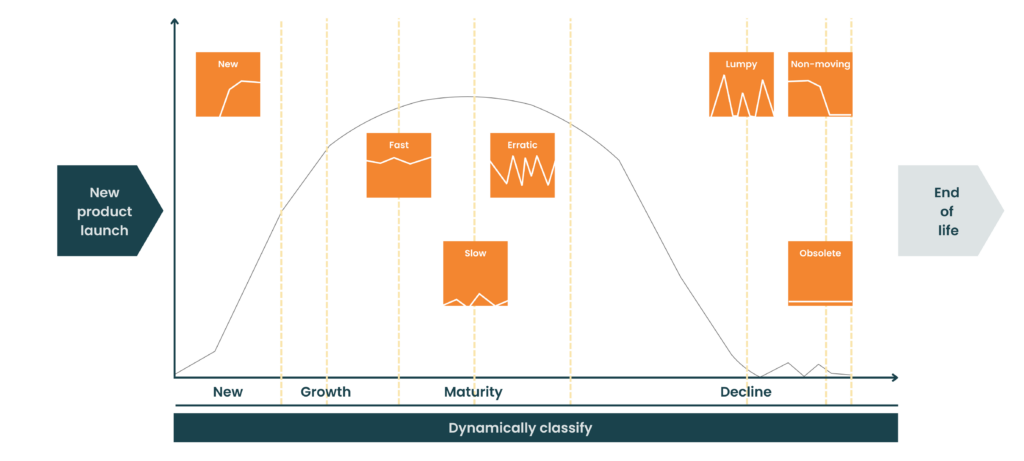
The rate at which inventory items can turn obsolete will differ, depending on what the product is and its industry or marketplace. For example, in the high fashion and technology markets, tastes change quickly, with new products continuously replacing older models. Goods with a short shelf-life are also at higher risk of degradation and swiftly reaching obsolescence. Whilst in sectors with long-lasting machinery, for example boilers or cars, service parts may not become obsolete for many years.
Inventory obsolescence is often caused by businesses failing to understand the product life cycles of the items they stock and consequently missing the warning signs of those nearing their end. If they haven’t accurately forecasted a decline in demand or effectively adjusted their stock replenishment parameters, they will often be left with obsolete goods.
Inaccurate forecasting and poor inventory replenishment practices are key reasons for obsolete inventory. When a business is carrying excess inventory, e.g., more stock than demand requires, stock must be reduced accordingly. Otherwise, it will become obsolete if the items have no demand, deteriorate, or pass their sell-by-date.

Why is inventory obsolescence a problem for businesses?
While obsolete inventory remains in a business, there are a number of financial repercussions it has to burden:
- It ties up working capital, which looks bad on the balance sheet and means it cannot be invested in other aspects of the business, such as marketing, recruitment, technology, or other inventory items.
- It uses up valuable space in the warehouse and increases all carrying costs
- It affects inventory turnover ratio
- It usually leads to stock being sold at a discounted price, e.g., a lower net resaleable value, or being written off altogether. Therefore, it hits a business’ bottom line at the end of the year, when the cost is usually absorbed in the Cost of Goods Sold on the profit and loss sheet.
For these reasons, it’s important to get rid of obsolete inventory as quickly as possible (see below).
Obsolete inventory management policies – KPI examples
It’s important to keep track of your stock levels and look out for signs of inventory obsolescence. Possible inventory KPIs to use include monitoring your inventory turnover ratio or calculating
inventory as a percentage of sales.

Some accounting principles also recommend calculating and monitoring your obsolete inventory percentage:
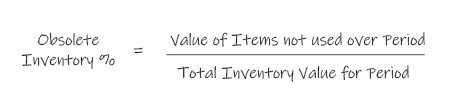
Whilst caution needs to be taken as these calculations are simplistic (for example, they don’t take into account seasonality), monitoring these KPIs could help indicate when levels of excess stock are rising.
Unfortunately, manually calculating these KPIs is time-consuming, and, if they’re not regularly updated, then you could easily miss any potential warning signs of stock levels beginning to rise!
That’s why many businesses use enterprise resource planning (ERP) or warehouse management systems (WMS) to help with their inventory management. Such systems can track inventory levels, often in real-time, and provide basic KPIs to help monitor obsolete stock. Inventory optimisation software, such as EazyStock, takes this one step further, calculating and reporting on healthy, excess and obsolete inventory levels of every SKU daily.
Obsolete inventory management
If you have obsolete inventory in your business, there are a number of ways to manage it and get rid of it. These include:
Sales promotions: you may be able to generate demand for the items if you sell them at a discounted price. Or, perhaps you can add them to product bundles, to make a different customer offer more attractive?
Find new markets: perhaps you can offer the products to a different marketplace, e.g. a different industry or country?
Sell to a stock surplus specialist: it’s possible to sell off obsolete inventory to a business specialising in selling excess, obsolete and liquidation stock. Be warned, you’ll do so at a heavily discounted price, though this could be a better option than writing it off altogether.
Writing it off: sometimes you have no choice but to dispose of the goods, e.g. they are out-of-date or have degraded in quality.
A proactive approach to inventory obsolescence
Having a plan to remove obsolete inventory is a necessity, but it’s also like closing the barn door after the horse has bolted! Taking a proactive stance is much wiser. With effective stock policies, you can proactively reduce excess stock and consequently avoid the problem of inventory obsolescence from occurring in the first place.
These include:
- Accurate demand forecasting
- Efficient stocking policies and real-time stock tracking
- Accurate re-order points
- Well-monitored KPIs
Read our blog on how to reduce excess and obsolete inventory for more advice.
Put your inventory obsolescence policy into action now!
Many companies are unsure what to do with obsolete inventory once they have it and make the mistake of not acting right away, as they want to avoid accounting implications. Be warned: if you don’t address obsolete inventory as soon as possible, it will just continue to grow.
Make sure you have a plan in place, and once you’ve reduced your obsolete stock levels, start to think about how to avoid getting into the same situation in the future. Inventory optimisation software is one way to do this – contact our team today for more details.
FAQs about Obsolete Inventory Management
Obsolete inventory is stock that has been in the warehouse without any demand for at least 12 months. It will have started as excess stock, but demand will have continued to fall until there isn’t any. To identify obsolete stock, review demand for all items in your warehouse and mark anything that hasn’t had any demand for at least 12 months. These are your obsolete items.
Inventory obsolescence is often caused by businesses failing to understand the product life cycles of the items they stock and consequently missing the warning signs of those nearing their end. If they haven’t accurately forecasted a decline in demand or effectively adjusted their stock replenishment parameters, they will often be left with obsolete goods.
Inaccurate forecasting and poor inventory replenishment practices are key reasons for obsolete inventory. When a business is carrying excess inventory, e.g., more stock than demand requires, the stock must be reduced accordingly. Otherwise, it will become obsolete if the items have no demand, deteriorate, or pass their sell-by-date.
Prevention is better than cure, so it’s best to ensure you have efficient inventory management practices in place to stop excess from piling up and becoming obsolete. Once you have excess inventory, work quickly to stop it from becoming obsolete. Some ways to reduce excess stock include:
- Run sales promotions and offer discounts. See if you can bundle items together to make them more attractive to customers.
- Investigate new markets and see if there are new audiences for your items. This could be a different industry or country – if you’re B2B, can you sell B2C? You could also investigate new sales channels, such as third-party websites.
- Sell your stock to a surplus specialist who will take your items off your hands, but this could be a heavy discount.
- The final option is to write off the goods and dispose of them. While this won’t bring in any money, you won’t continue to incur holding costs.
Overstocking increases carrying costs, including capital costs (related to investment in stock), storage space costs (warehouse, mortgage, maintenance), inventory service costs (insurance, security, hardware, physical costs), and inventory risk costs (insurance to cover shrinkage, wastage, obsolescence).
As excess stock becomes obsolete, it becomes harder to sell profitably, if at all. This diminishes return on investment, impacting the bottom line and shrinking profit margins.
Effective stocking policies help to proactively reduce excess stock and avoid the occurrence of inventory obsolescence. Proactive strategies to prevent obsolete inventory are:
- Improve demand forecast accuracy – statistical demand forecasting from inventory optimization software like EazyStock analyzes every product and assigns a demand type according to its product life cycle stage to use the most relevant algorithm. It will dynamically update the algorithm as the demand profiles change to maintain forecast accuracy.
- Don’t use excess stock to mitigate supply risks – Plan for holidays or supplier shutdowns in advance. Entering these dates into EazyStock will update order profiles to reflect them and provide automated recommended orders. Keep track of supplier lead times and assess if they are meeting their SLAs. EazyStock can also calculate appropriate safety stock levels to mitigate supply risks.
- Stop carrying excess inventory to prevent stockout – You can achieve high service levels and stock availability without carrying high volumes of all items. Prioritize items using ABC XYZ inventory classification to set appropriate stocking policies that define individual stock levels and associated fulfillment targets.
- Optimise inventory levels along your supply chain – A view of stock levels across all locations can balance out inventory, allowing you to redistribute excess stock from one location to other sites with low levels of the same item before needing to order more from the supplier. This quickly removes surplus stock and minimizes the risk of obsolete items.
- Buy stock wisely – It’s tempting to buy in bulk for the best price on an order, especially for fast-moving items. However, for slower-moving items with erratic or declining demand, it can cause problems. If bulk offers don’t match items’ demand profiles, you might save money on inventory costs, but if the items don’t sell, you’ll tie up capital in excess stock, risk obsolescence, and the need to sell at a discount. Where you have high supplier minimum order quantities (MOQs), see if you can renegotiate with your suppliers or find alternatives with lower MOQs. It may be better to pay a higher unit rate for smaller order quantities than have cash tied up in stock that isn’t moving through the warehouse fast enough.
Inaccurate forecasts misrepresent actual demand, leading to buying items that won’t sell. This often happens when forecasts rely on rolling averages or month-on-month reviews. Manual forecasting with spreadsheets can become difficult to manage and is open to human error. A simple error in a spreadsheet can inflate orders unnecessarily.
Manual forecasting also treats all items the same, rather than adapting the forecasting algorithm and calculations to suit each item’s demand profile. Automated forecasts that consider more variables will improve forecast accuracy and align stock levels with actual demand, preventing excess stock and reducing the risk of obsolescence.
If you can sell obsolete inventory even at a loss, it will help recover some of the capital investment, so this should be the chosen option where possible. Inventory should only be written off if there isn’t another viable option.
Automated inventory software provides alerts when demand profiles change for inventory items and stock levels begin to exceed demand. This allows the team to investigate and take action before the items become dead.
Automated systems adapt the forecasting algorithm to reflect the new demand profile and adjust recommended orders to prevent excess stock building up.