
Mastering stock control: Cut costs, avoid stockouts, and keep customers happy

As a stock-holding business, you’ll have experienced having a customer ready to buy, only to discover you’re out of stock. You’ll also be familiar with the opposite situation: shelves full of products tying up cash that don’t have demand.
For small and medium-sized businesses, stock mistakes are amplified: one missed reorder can mean lost revenue for the week, while overbuying can limit the cash you need for payroll, marketing, or suppliers. The good news is that achieving the right inventory balance doesn’t have to be complicated. You just need a few clear rules and consistent routines.
In this guide, you’ll learn what stock control means, the key practices behind it, and some simple strategies to support small SME teams who are struggling with limited time and cash flow.
What is stock control?
Stock control is how you keep the right items in the right places and in the right quantities, without tying up cash in excess stock or running out of stock. It aims to ensure product availability to meet customer demand.
For SMEs, it means establishing clear rules for everything from purchasing and storage to tracking and fulfilment, ensuring the numbers in the system match what’s on the shelf. The right information helps purchasers make data-driven decisions, provide accurate demand forecasts, spot trends early, and balance stock levels.
For example, if you have items with seasonal demand profiles, you need to align replenishment with seasonal patterns. Overstock, and you’re forced to discount excess stock that impacts margins and cash flow. Understock, and you lose sales and customers when demand spikes.

Stock control isn’t about counting boxes. It helps you find the right stock balance so you can grow without constantly firefighting.
Why is stock control important?
Stock control is a “behind-the-scenes” discipline, but it delivers benefits across the business, boosting profits and service levels while reducing stress. The biggest benefits include:
- Healthier cash flow: Less money tied up in slow movers means more flexibility for payroll, marketing, supplier payments, and investment in the right stock.
- Happier customers: Fewer stockouts lead to fewer lost sales and more repeat purchases.
- Less waste and clutter: Improved rotation and smarter buying reduce obsolescence and free up valuable warehouse space.
- Faster, data-led decisions: Reliable stock data supports balanced replenishment and helps you plan promotions, negotiate with suppliers, and respond to trends quickly.
- Easier reporting and compliance: Clear records support audits, accounting, and industry requirements.
Hidden costs of poor stock control
While full shelves might seem like a strength, if they’re holding stock that customers don’t want and none of what they do want, the cost is higher than you might realise. Here are some of the hidden costs and disadvantages of poor stock control:
Cash tied up in stock
Every pallet, box, or bag of stock you hold is cash trapped in physical form, making it unusable elsewhere. £10,000 of slow-moving stock is £10,000 you can’t use to pay staff, invest in company assets, or buy fast-moving items. If this slow-moving stock goes unnoticed and you keep ordering more, you’ll keep tying up more cash. If demand for that slow-moving stock stops completely, you’ll be left with dead stock that must be sold at a heavy discount or written off.
Lost sales and stockouts
Instead of tying up cash in stock, it can be tempting to understock. However, this carries its own costs. If you run out of an item your customer needs to keep a job moving or to keep one of their customers happy, they’ll take their whole order to a competitor.
Reliability is just as important as price: you don’t lose one sale; you risk losing long-term customer trust, loyalty, and repeat revenue.

Overstock and obsolescence
Supplier deals often seem like a smart move, but bulk buying can end up costing more if demand doesn’t match supply. Extra pallets could sit for months or years, deteriorating, getting damaged, or becoming obsolete as product ranges and trends change, while taking up valuable warehouse space.
Obsolete stock can creep up on you, quietly eroding your profits through higher holding costs with no prospect of a return on your investment. Bulk deals are only worthwhile if you have upcoming demand.
Increased carrying costs
Restricted cash flow and product obsolescence aren’t the only costs you’ll incur with poor stock control.
- You’ll pay more for storage as every space in your warehouse has a cost.
- Handling costs increase as more stock needs more staff to move, check and count it.
- Shrinkage adds up due to theft, loss or misplacement.
- Insurance premiums rise as stock values increase.
Individually, these costs seem small. When combined, they can reduce your stock value by 20-30% annually. That means £100,000 of slow-moving stock could be costing you £20,000 to £30,000 just to hold in your warehouse.
The cost of inaction
Leaving things as they are is just as costly. Beyond financial costs, poor stock control increases stress by requiring more firefighting and wastes time that could be spent on more strategic, value-adding tasks. The good news is that these costs are avoidable. With the right tools, processes and habits, stock can stop being a burden and become your greatest asset.
Does your stock control need attention?
Even with good intentions, stock control can become messy, especially as businesses grow. Common stock control issues include inaccurate records, unpredictable demand, limited storage space, supplier delays or minimum order quantities, and multi-channel selling.
Use this quick checklist to see whether your stock control needs attention. Do you:
- Regularly experience unexpected stockouts?
- Have piles of dead stock that won’t sell?
- Frequently place rush orders to cover low stock levels? or
- Often see mismatches between your system and what’s actually on the shelf?
Read on to learn how you can overcome these issues and take control of your stock.
Modern stock control is also data-driven. Tools such as barcode scanning, real-time inventory dashboards, and automated reorder alerts reduce human error and help you respond more quickly to changes in demand or supplier delays.
Key elements and practices of stock control
Stock control isn’t just a management job; it’s a team habit, and everyone plays a role in how effectively your stock works for you. If your team isn’t aligned, your stock will always drift out of control.

Most staff don’t understand the true cost of stock. They see piles of goods, not piles of cash. Hold a short training session to explain that stock is cash, dead stock is wasted money, and stockouts mean lost customers.
It’s best to keep stock control simple, maintain consistency, and focus on key items to make it easier for your team to follow. You can make stock control visible by displaying the top 20 fast movers and the top 10 dead-stock lines on the office wall, using a traffic-light system for stock levels, and sharing monthly KPIs in team meetings. Don’t forget to celebrate wins.
Core stock-control elements to help keep SMEs on track include:
- Accurate inventory tracking: Know what you have, where it is, and what’s available to sell, using a system that’s consistently updated.
- Regular stock audits: Compare physical counts with your records to identify discrepancies caused by damage, theft, supplier errors, or administrative mistakes.
- Accurate demand forecasts: Use sales history, seasonality, and promotions to predict what you’ll need to avoid both shortages and overbuying.
- Flexible reorder points and stock rotation: Set reorder points, particularly for top sellers, and sell older stock first, especially for items with expiry dates, to protect margins and reduce waste. Revisit reorder points when demand or market conditions change.
- Categorising inventory: Using ABC analysis to categorise stock helps focus limited time on key items. Count ‘A’ items more often and set tighter reorder points. Lower-priority ‘C’ items can be reviewed less frequently.
- Organised storage: Keep inventory accessible, clearly labelled, and secure to make counting and order picking faster and more accurate. ABC inventory classification can make this easier.
- Preventing losses: Reduce shrinkage through clear processes, access controls, and accountability to protect stock and ensure traceability.
- Assign a stock accuracy owner: Even if multiple people handle picking and receiving, clear ownership can reduce mismatches between what the system shows and what’s on the shelf.
- Running weekly spot-checks: Perform weekly checks on your 10–20 high-movement SKUs.
- Creating a single source of truth: Create a simple, central dashboard that displays 3–5 key metrics you can track weekly, such as stockouts of top sellers, dead stock value, items below the reorder point, and supplier lead time issues.
- Combining Just-In-Time (JIT) and Just-In-Case (JIC) stock control: Use JIT for predictable lines to conserve cash, and JIC (safety stock) for critical items where delays would cause stockouts.
How can software help with stock control?
For many SMEs, spreadsheets form the foundation of stock management. When one person is responsible, and the product range is manageable, they can help businesses track stock levels, reorder points, and slow movers. You can also use them to run simple ABC analysis, create monthly dashboards, and generate basic forecasts.
However, spreadsheets become fragile as more people edit them or as you add more items, channels, or locations. Errors creep in, and decisions are based on inaccurate data. When that happens, entry-level inventory software or your ERP’s inventory features provide greater control.
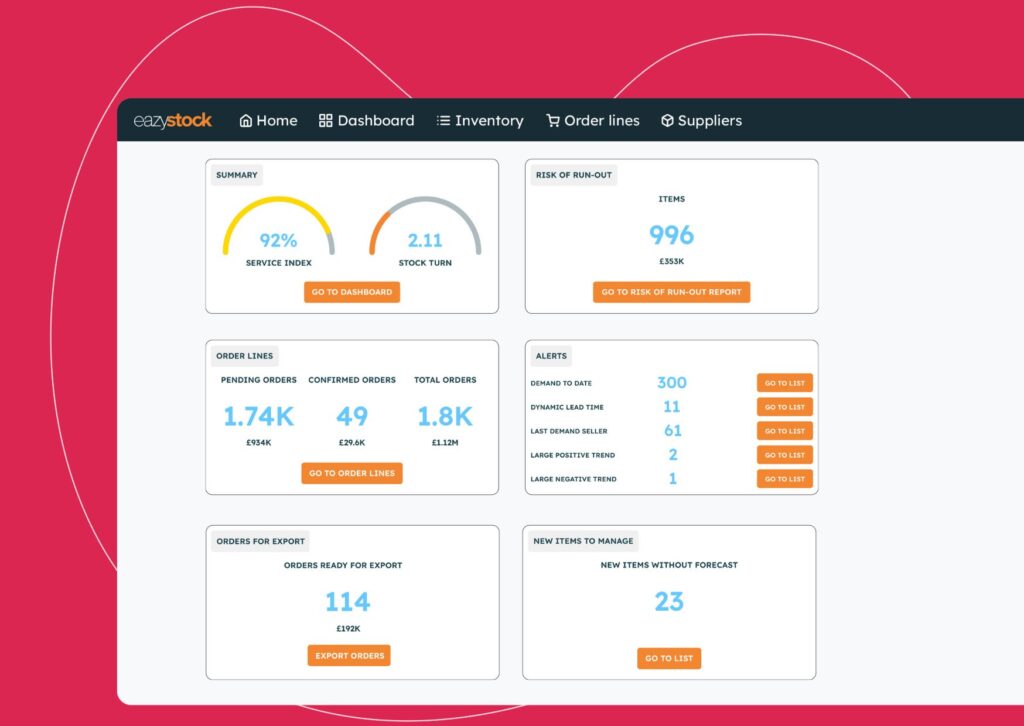
Specialist tools like EazyStock can go further by integrating with your ERP system to provide a central overview of your inventory. EazyStock automates manual processes and uses advanced algorithms, seasonal demand profiles, product lifecycle data and demand trends to improve demand-forecast accuracy. Automated stock control optimises inventory by calculating reorder points, optimal order quantities and safety stock levels, improving inventory availability, reducing costs and saving time.
Build a stock control system you can trust
With stock control, don’t aim for perfection. Start by increasing visibility and building consistency, one process at a time. By getting the basics right, you’ll see fewer stockouts, less waste, and smoother day-to-day operations.
Here is an example of how to start your stock control journey:
- Now: pick your top 20 products and set reorder points.
- This week: introduce a weekly cycle count for fast-moving items.
- This week: document a simple one-page receiving process and train the team.
- This month: review dead stock and decide how to deal with it. This could include running a promotion to discount it, bundling it with other items, returning it, or scrapping and discontinuing it.
- This month: Consider inventory optimisation software and how it can support your processes.
Stock control FAQs
Lagerstyrning skapar värde i hela verksamheten. När lagret är under kontroll ökar lönsamheten, servicegraden förbättras och den dagliga stressen minskar. Med rätt information får inköpare ett stabilt beslutsunderlag – vilket gör det lättare att arbeta datadrivet, ta fram mer träffsäkra prognoser, upptäcka trender i tid och hålla lagernivåerna i balans.
Lagerstyrning består av flera arbetssätt som tillsammans hjälper företag att hålla lagret i balans.
Vanliga metoder är att sälja de äldsta artiklarna först (FIFO‑principen), ta emot varor först när de behövs (Just‑in‑Time) och använda ABC‑analys för att kategorisera artiklar och prioritera rätt. En annan viktig del är att arbeta med flexibla beställningspunkter som anpassas efter efterfrågan.
Den gyllene regeln i lagerstyrning är att ha rätt artiklar, på rätt plats och i rätt mängd, utan att binda onödigt kapital i överlager eller riskera bristsituationer.
Det kräver tydliga spelregler för hela lagerarbetet, från inköp och lagring till uppföljning och leverans, samt att det som visas i systemet faktiskt stämmer med det som finns på hyllan.
En bristsituation uppstår när företaget inte har tillräckligt med varor i lager för att möta efterfrågan.
Det kan tvinga fram restorder eller dyra expressinköp, eller i värsta fall leda till att kunden vänder sig till en konkurrent.
För att lagersaldon ska vara tillförlitliga krävs regelbundna inventeringar, med frekvens anpassad efter bransch och artikeltyp.
För många företag är cykelinventeringar mest effektiva, där utvalda, ofta snabbrörliga artiklar räknas löpande varje vecka eller dagligen. Det ger högre noggrannhet med mindre påverkan på den dagliga verksamheten.
En beställningspunkt är den lagernivå där det är dags att lägga en ny order. Den kan hanteras manuellt eller automatiseras med hjälp av mjukvara, och baseras på artikelns ledtid och efterfrågan.
För att undvika både överlager och bristsituationer är det viktigt att regelbundet se över beställningspunkterna när efterfrågan förändras.
För att förbättra lagerstyrningen behöver du säkerställa att lagersaldon och efterfrågeprognoser är korrekta och tar hänsyn till viktiga faktorer som säsong, variation och ledtider.
Arbeta med flexibla beställningspunkter och tydlig lagerrotation, kategorisera sortimentet med hjälp av ABC‑analys och organisera lagret så att plock och packning sker effektivt. Minst lika viktigt är att utbilda teamet, så att alla arbetar mot samma mål.
Specialiserad mjukvara kan dessutom automatisera mycket av detta arbete och minska det manuella inslaget i lagerstyrningen, vilket sparar tid och ökar precisionen.