Why specialist software beats generic AI for inventory and supply chain decisions

AI is having a moment. It can write emails, summarise reports, answer questions in seconds, and make almost any task feel faster. In the right setting, it offers many benefits.
However, when businesses try to apply AI to every problem, it can create new risks, especially in areas where accuracy, context and repeatable decision-making matter. When it comes to inventory management and supply chain planning, speed is only part of the story. What really matters is whether a tool can consistently help you make the right decision at the right time, using the right data.
Generic AI can be brilliant for ideas, summaries and quick explanations, but if you are trying to decide what to reorder, when to place a purchase order or how to balance stock availability with working capital, you need more than a clever answer. You need software built for that job from the ground up, which is where specialist software still has the edge.
Generic AI is useful, but it isn’t built for inventory decision-making
General-purpose AI tools are designed to be broad, which is both a strength and a weakness. While they can explain concepts, suggest next steps and help teams work faster, they don’t understand the rules, constraints and commercial realities that shape your day-to-day operations.
For example, your business might work with suppliers that have minimum order quantities (MOQs) or minimum order values, or with variable lead times. If you’re holding thousands of SKUs, it’s unlikely they share the same seasonal or general demand patterns, service-level targets or cash-flow pressures.
These are the details that shape sound inventory decisions, but they are difficult to manage with generic prompts alone. Inventory optimisation software will have specific features and functionality to support MOQs, minimum order values and variable lead times.
Inventory optimisation needs more than clever prompts
If you’re starting with poor data or unreliable manual processes, AI won’t fix them; it only works with the data you provide. Poor inputs will produce poor outputs, so your purchasing still won’t be right.
Whether you’re using AI, spreadsheets, or specialist software, up-to-date, accurate data is essential for reliable outputs.
Once your data is reliable, it’s not enough to simply plug it into AI. A one-off prompt to AI will produce a one-off answer for that moment; it isn’t continuously reading and analysing the data you provide. Purchasing teams need repeatable calculations, live data, workflows and auditability to deliver consistent, reliable forecasting and replenishment parameters.
Safety stock is a good example. AI can explain what safety stock is and why it matters, but that doesn’t mean it can reliably calculate the right level for your business. You can load the right data, planning logic, and operational rules into AI, but you are only getting information for that moment.
AI isn’t continuously reviewing your inventory data, so it won’t detect demand changes or send alerts for you to review. By the time you’ve noticed an issue, such as a demand spike or drop, it will be too late. Your replenishment will be inaccurate, leading to preventable stockouts or overstocks.
ERP data needs specialist inventory optimisation, not just AI analysis
Your ERP system holds valuable operational data, but it likely lacks the specialist logic to translate that data into forecasts, order proposals, safety stock levels and service-level decisions.

Most ERP systems offer limited inventory management and planning functionality, forcing businesses to rely on time-consuming manual processes. While uploading data to an AI engine might seem like a quick win and a way to streamline your processes, it’s just adding another step to an already lengthy process.
This is why many businesses integrate their ERP systems with specialist software to extend their capabilities without replacing the core system. By combining ERP data with the advanced functionality of inventory optimisation software, manual processes are automated and accurate forecasts are generated, aligning orders with actual demand.
Specialist software turns insight into action
That’s not to say AI doesn’t have a place in inventory management; it can support decision-making. Specialist software is designed to translate those decisions into practical, consistent and usable business outputs.
For example, you can use AI to help brainstorm a supplier email or summarise a report. You can also use it to understand broader inventory management best practices or issues.
The biggest strength of specialist software is its clear purpose, rather than trying to be everything to everyone. It’s designed to solve a real business problem, so its logic, workflows and reporting are built around outcomes that matter.
In supply chain and inventory management, that means helping teams reduce excess stock, avoid stockouts, improve forecast accuracy and place better orders with less manual effort. It also means integrating with existing systems and automatically pulling through information, rather than becoming another place to look for information manually.

Integration matters more than you might realise. Unlike standalone AI tools, specialist software works with live ERP data, making outputs more trustworthy and consistent.
When knowledge sits in one person’s head or depends on ad hoc prompting, processes become fragile. Specialist software provides teams with a shared framework for decision-making, reducing guesswork and making planning easier to scale.
Trust matters for inventory management decisions
Poor inventory management decisions are costly and can have hidden consequences for the business. Excess stock ties up cash and increases holding costs, while insufficient stock reduces availability, frustrates customers and creates pressure across the wider business. This makes it essential to trust data outputs.
People need to understand how decisions are made and feel confident acting on them. If a tool produces answers that sound convincing but are difficult to validate or rationalise, it becomes hard to rely on. Specialist software provides this trust because it is built around a defined use case, measurable logic and repeatable rules.
AI still has a role, just not as a replacement
AI can absolutely support supply chain teams by helping users interpret data, answer questions more quickly, surface trends, or reduce the time spent on low-value admin. However, the heavy lifting still needs to be done within software designed for the problem.
The businesses that get the most value will be those that combine both. They will use AI where it helps people work faster and specialist software where accuracy, consistency and action matter most. Used that way, AI becomes a useful layer of assistance rather than a risky substitute for specialist capability.
What businesses should look for instead of AI hype
If you are evaluating tools right now, it helps to ask a few simple questions.
- Is this built to solve the problem we actually need to solve?
- Does it integrate with our ERP or other business systems?
- Can it turn data into recommendations that teams can act on?
- Is the logic clear enough to trust?
- Will it help us improve decision quality and save time?
Solutions that answer those questions will have a lasting positive impact on your business. While specialist software might not have the same buzz as AI, it often delivers the day-to-day value that inventory teams need. Rather than relying on repeated data downloads and manual uploads, it fits the way your business works, helps people make better decisions, and delivers value day after day.
That is exactly why specialist tools such as EazyStock come into their own. EazyStock is a specialist inventory optimisation platform that combines purpose-built inventory planning functionality with AI-supported insights.
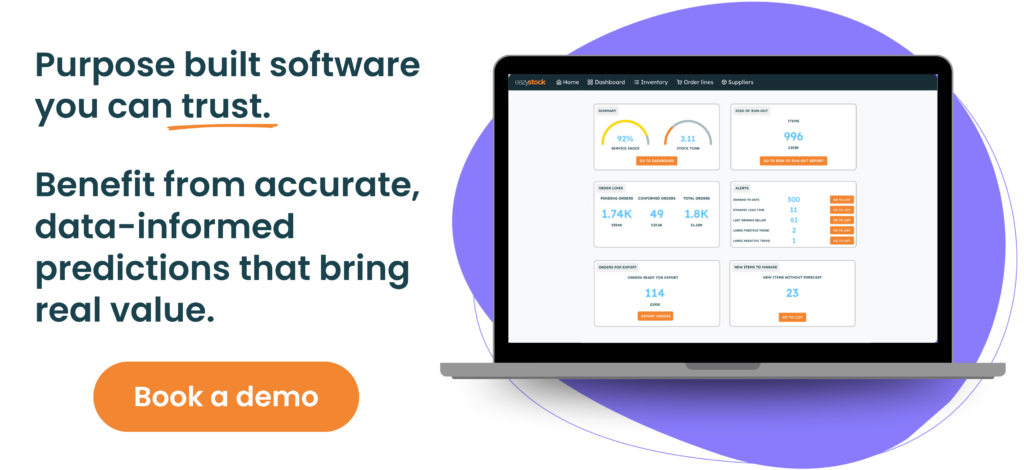
It connects to ERP and business systems to improve forecast accuracy, optimise inventory levels and generate supplier order proposals. It does so within a workflow designed for real purchasing teams rather than generic prompts.
For businesses that want smarter decisions without adding more manual effort, purpose-built software is often where the real value lies.
To understand how EazyStock can help you make better inventory decisions from your data, get in touch with our experts.
FAQs
Generic AI is designed to handle a wide range of tasks, such as writing, summarising and answering questions. Specialist software is built to solve a specific business problem. In supply chain and inventory management, this means using real business data, planning logic and workflows to support better operational decisions.
Not on its own. AI can support inventory teams by helping them interpret information and answer questions more quickly. However, inventory management also depends on consistent, accurate forecasting, replenishment rules, supplier constraints and system integration. That is why specialist software remains essential.
Specialist software is built around the real decisions supply chain teams face every day. It can work with ERP data, demand patterns, supplier lead times, and service-level targets to generate consistent, practical recommendations. That makes it far more useful than generic AI alone, which cannot make accurate, repeatable decisions.
Yes, absolutely. AI can save time, improve access to information, and help users explore data more quickly. The strongest approach is usually to use AI alongside specialist software, not instead of it. That way, businesses get the speed and convenience of AI without sacrificing the structure and reliability of purpose-built tools.
It helps to look for software that is designed for your specific planning challenges, connects with your ERP or business systems and turns data into clear actions. The best tools should also make decision-making more consistent, reduce manual effort, and give teams more confidence in their decisions.