Where generative AI can help supply chain and purchasing teams

Generative AI has moved fast. What started as a boardroom buzzword is now being tested by many teams in their day-to-day work. It can be confusing to know how and when to use it, particularly for supply chain and purchasing teams. The question isn’t whether teams should use it; it’s where it actually adds value.
The answer is; not everywhere. AI is best used when it helps people work faster, communicate more clearly, and make sense of information that would otherwise take too long to review manually.
For planners, buyers and purchasing teams, that means using AI to support summarising supplier updates, drafting communications, explaining reports and creating process guidance.
It isn’t about handing over inventory decisions to AI. It’s about providing a faster way to understand, share and act on the information that informs those decisions.
In this first blog in our four-part AI and inventory management series, we look at six practical ways generative AI can support supply chain and purchasing teams, and where human judgment and experience are essential.
Why the distinction matters
Supply chain planning is not just about finding an answer that sounds right. It needs accurate data, clear rules and a solid understanding of suppliers, lead times, seasonal demand, service targets and stock levels.
That is where specialist inventory optimisation software comes in. It is designed to calculate demand, safety stock, reorder points, and purchasing recommendations using proven planning logic that accounts for the variables above. It also provides the data in the right context. Relevant dashboards, KPIs, and alerts highlight the key aspects of the data you need. Without the right context and understanding of your business, the data can be misinterpreted, or you could miss key issues and cause more problems. Generative AI’s strength lies in helping teams explain those decisions, share updates, and make information easier to act on.
So, where does AI fit in? Here are six practical ways planners, purchasers and buyers can use it to save time, cut through the noise and focus on the decisions that need their expertise.
1. Summarising supplier updates and communications
Purchasing teams handle a steady stream of emails, order acknowledgements, supplier updates, price changes and delivery messages. With so much coming in, it is easy for important details to get lost in long threads or busy inboxes.
Generative AI can extract key points, highlight actions and turn supplier updates into plain English. For example, it could review a lengthy supplier email, flag that a shipment is 5 days late and that 2 product lines are affected, and alert the buyer to confirm whether to split the order.
This doesn’t automatically change the plan, but it can help buyers spot issues sooner and confidently take the next step.
2. Drafting internal updates and supplier messages
When stock availability changes, customer service, sales, operations and finance often need a quick, clear update. The challenge is to translate planning data into a message each team can understand and act on.
Generative AI can help draft those updates, whether that is a short note for sales, a supplier query, or an escalation message. For example, a planner can turn a report into a simple summary, while a buyer can quickly draft a message asking a supplier to confirm revised lead times.
The benefit is simple: teams spend less time starting from scratch and more time reviewing the details and moving the issue forward.
3. Explaining reports in everyday language
Supply chain reports can be full of useful data, but they aren’t always easy to digest, especially for other teams. Metrics such as forecast error, service level, excess stock, inventory turnover and supplier reliability matter, but they need to be easy to understand.

Generative AI can turn those reports into clearer explanations by summarising what has changed, explaining why a metric matters, and producing tailored versions for different audiences. A supply chain manager may need operational details, while the leadership team may only need the top risks, financial impact, and recommended actions.
Used well, this makes data more accessible and enables more productive conversations. Instead of spending half the meeting working out what the numbers mean, teams can focus on next steps.
4. Creating training content and process guidance
Planning and purchasing processes can be complex, particularly for new starters or teams working across multiple sites. Existing documents may be too long, too technical, or out of date.
Generative AI can turn process notes into training materials, quick-reference guides, FAQs, checklists and practical examples, and if you want to get your message to a wider audience, you can even use it to create a podcast. It can also explain inventory planning concepts, such as safety stock, reorder points and ABC analysis, in a way that is easier for non-specialists to follow.
That can make onboarding easier, support change management, and help teams work more consistently. When people understand the basics, they can follow the process and ask more informed questions.
5. Surfacing insights from unstructured information
Not every useful supply chain insight fits neatly into an ERP, inventory management system, or planning platform. Some of it lives in emails, meeting notes, supplier documents, market updates, and customer feedback.
This is where generative AI can be particularly useful. It can scan large volumes of text and highlight recurring themes, risks or questions. For example, it might flag that several suppliers are reporting longer lead times, that customers keep asking about a specific product group, or that internal teams are unsure about a new purchasing process.
Those insights can help teams ask better questions and investigate sooner, using them as prompts for review rather than as final answers.
6. Supporting scenario discussions
Scenario planning often brings together data, assumptions and input from multiple teams. What happens if a supplier extends lead times? What if demand spikes suddenly? What if a promotion sells faster than expected?
Generative AI can help structure those discussions by drafting scenario templates, preparing meeting questions or summarising potential business impacts. It can help teams think through the information they need, who should be involved and which options are worth exploring.
It can also help with issue resolution. If a supplier delay, demand spike, or stock imbalance creates a problem, AI can pull together the key details and compare possible responses. Should the team expedite the order, split the shipment, move stock from another location, or update customers on revised availability? AI can help frame those options and highlight the trade-offs, enabling teams to reach a decision faster. However, the final call still requires accurate data, planning logic and human judgement.

The final planning recommendation, however, should still come from a system that understands the numbers. AI-generated summaries can be useful, but they should be based on accurate forecasting, inventory and purchasing logic.
Where generative AI should be used with caution
Generative AI is powerful, but it isn’t always precise. It can give confident-sounding answers that still need checking, especially when the data is incomplete, out of date, or missing important context.
That makes it less suitable as the basis for decisions such as how much stock to buy, when to reorder, which items need higher safety stock, and how to balance service levels against working capital. These decisions need clear calculations, live data and planning rules that reflect how the business actually operates.
When using AI, data privacy, access rights and governance matter too. Supplier contracts, pricing, customer demand and inventory positions can be commercially sensitive, so teams need clear rules on which information can be used, where it is stored and who can access the outputs.
A practical way to think about AI in the supply chain
Generative AI has a useful role to play in supply chain and purchasing. It can cut admin, improve communication, support training and help teams spot useful signals in information that would otherwise be hard to review.
However, it shouldn’t be treated as a magic wand for inventory management. The best results come when businesses combine AI with reliable systems, clean data and experienced people who understand the commercial impact of each decision.
A simple way to look at it is this: use specialist inventory optimisation software to calculate the decision, and use generative AI to help people understand, communicate and act on it. The table below illustrates how this works in practice.
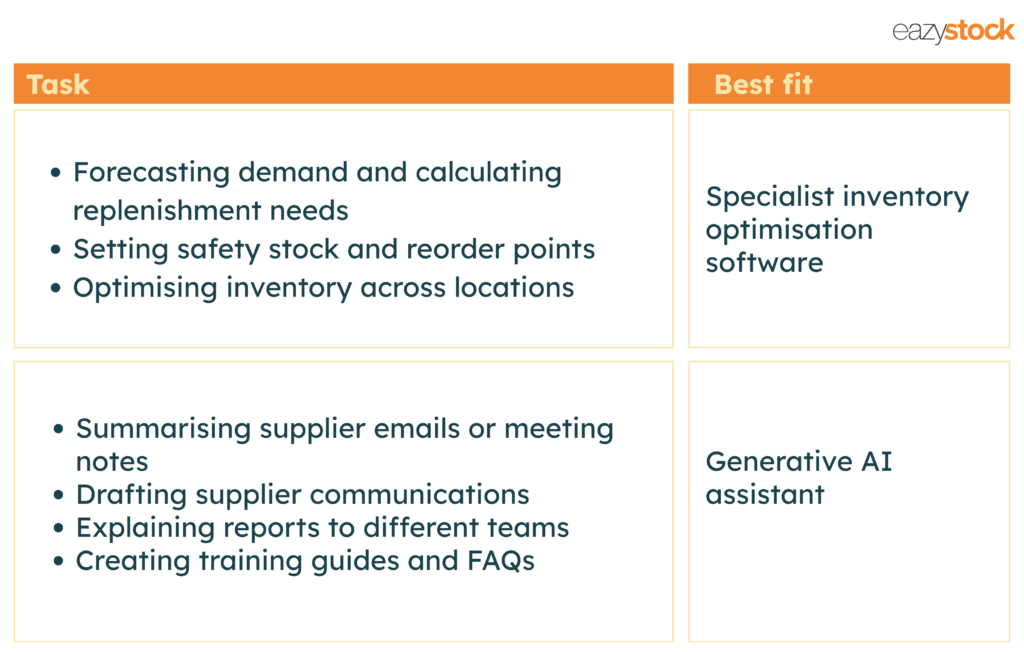
When used appropriately, they form a strong combination. Specialist inventory optimisation software provides the trusted recommendation, while generative AI helps teams understand, share and act on it faster.
The goal isn’t to replace planners, buyers or established planning tools. It is to help teams work smarter, move faster and explain what is happening more clearly.
So if AI is useful in these ways, can it go further and actually manage your inventory? We explore this in our second blog post, ‘Can generative AI really manage your inventory?’.
Want to explore how AI and specialist inventory optimisation can work together?
EazyStock helps purchasing and supply chain teams make smarter replenishment decisions, reduce excess stock and improve availability, using planning and purchasing logic designed for the real world. Contact our team to find out how it could help your business.
FAQs: Generative AI in supply chain and purchasing
Generative AI can help supply chain teams summarise supplier updates, draft internal communications, explain reports, create training content, and identify themes in unstructured information such as emails, meeting notes and supplier documents. It is most useful when it helps people understand and act on information more quickly.
Yes. Generative AI can support procurement teams by reducing administrative work and improving communication. For example, it can draft supplier messages, summarise contract or delivery updates, create comparison notes, and turn long email threads into clear actions. However, buyers should still review the outputs before making decisions.
Generative AI can support inventory planning by explaining reports, summarising issues and helping teams communicate recommendations. It shouldn’t be the primary tool for calculating forecasts, reorder points, safety stock or replenishment quantities. Those decisions need specialist inventory optimisation software with structured data and proven planning logic.
The main risks are inaccurate outputs, missing context, poor data quality and privacy concerns. Generative AI can sound confident even when it is wrong, so teams need clear checks, approval steps and rules for handling sensitive information, such as supplier pricing, customer demand and inventory data.
No. The strongest use case for AI is support, not substitution. Generative AI can reduce manual effort in communication, documentation and analysis, but experienced planners and buyers are still needed to validate recommendations, manage trade-offs and make commercial decisions.
A practical approach is to let inventory optimisation software handle the calculations, then use generative AI to explain, summarise and communicate the outcomes. This keeps planning decisions grounded in reliable data and helps teams work more efficiently.