What is the bullwhip effect?

Causes and effects of the bullwhip effect on supply chain performance
What is the bullwhip effect?
Small fluctuations in demand can escalate quickly. Fearing a stockout, you increase your order quantity, prompting your wholesaler and manufacturer to do the same. This results in excess stock, increased costs, and operational pressures throughout the supply chain.
This is the bullwhip effect.

The bullwhip effect in supply chain management occurs when small changes in customer demand are amplified as orders move upstream from retailers to wholesalers, manufacturers, and suppliers. Instead of aligning with actual demand, each stage adds safety buffers (safety stock), reacts to limited information, and overcorrects, thereby increasing variability rather than reducing it.
The effects of the bullwhip effect include excess inventory in some locations, stockouts elsewhere, unstable production schedules, increased logistics costs, and diminished customer service levels. Essentially, the bullwhip effect reduces supply chain performance by increasing costs and decreasing reliability.
Why the bullwhip effect matters
The bullwhip effect is important because it creates operational and financial pressures throughout the supply chain. Small shifts in demand can result in excess stock, tied-up capital, and higher storage and demand costs. Simultaneously, poor supply chain visibility increases the risk of stockouts, which can lead to dissatisfied customers. Below is a brief overview of common causes and the resulting effects of the bullwhip effect on supply chain performance.
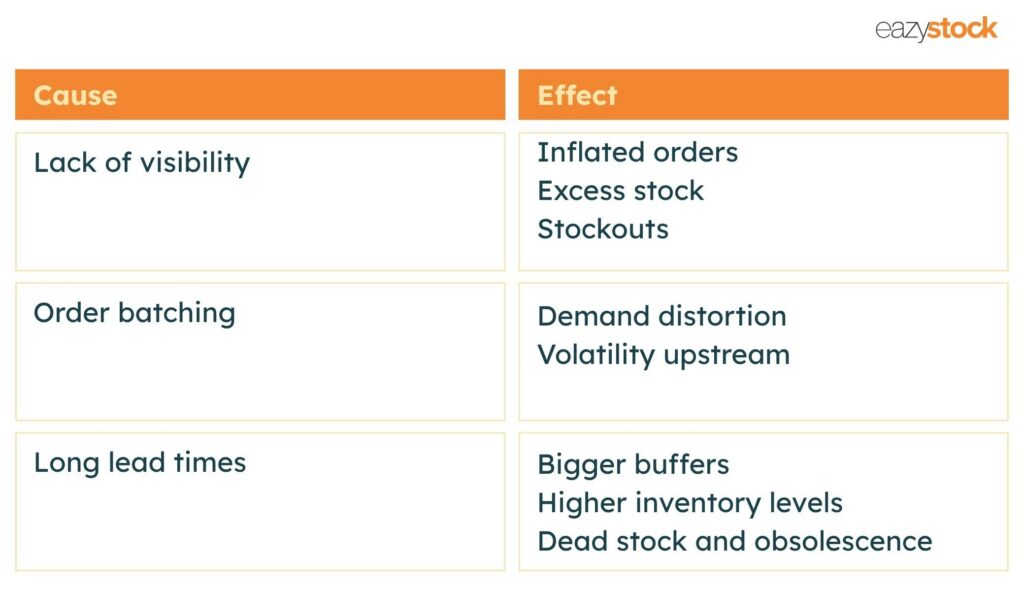
The bullwhip effect explained simply
The term ‘bullwhip effect’ comes from the image of wielding a whip. The handle doesn’t need to be moved much for the tail to move significantly. The term is used in supply chain management to illustrate how a small cause can accumulate into a large effect.
Here’s a simple description of how it can manifest:
- A retailer experiences a demand spike, so they order more from their wholesaler.
- The wholesaler sees the demand spike and orders more from the manufacturer, introducing a buffer into their order
- The manufacturer sees the large order and introduces their own buffer to protect against greater demand
Inefficiencies are therefore introduced at every stage.
What causes the bullwhip effect?
These inefficiencies can have a range of potential causes. Some of the more significant causes are:
Poor forecasting
The lack of information throughout the supply chain makes accurate demand forecasting more difficult. Consequently, this increases the likelihood of introducing buffers through inflated orders. It also increases the risk of firefighting efforts, which could exacerbate defensive measures, costs, and staff burnout.
Demand variability
Demand isn’t constant and can vary due to the weather, trends, product lifecycle changes and global events. For example, warmer weather usually increases demand for ice cream. However, once the heatwave ends, demand usually falls just as suddenly as it increased.
Lack of visibility
If a manufacturer can’t see the actual level of demand customers are experiencing, they can’t plan production levels accurately. To avoid stockouts, they might increase safety stock levels or increase production beyond order levels. This lack of visibility means they don’t know whether wholesalers can sell that stock.
Order batching
With so many orders to fulfil, it’s reasonable for manufacturers and wholesalers to optimise transportation and experience efficiency gains by batching orders. Consequently, delivery can be delayed at every stage of transportation, increasing the risks of a stockout. To cover this, they might buy alternatives or place new orders to fill the gap, creating an artificial demand spike.

Long lead times
Long lead times increase the risk of stockouts and potential revenue loss if customers turn to competitors.
Human behaviour
Bullwhip effects can also be triggered or worsened by human factors, as purchasing teams react defensively to avoid stockouts. This could mean increasing their safety stock levels in their orders. The supplier might then include a buffer in their order from the manufacturer, who might also add a buffer in their production levels.
Supply chains may appear to be entirely logical systems where production matches demand. However, they can still be influenced by emotional responses caused by a lack of visibility into what’s happening elsewhere in the supply chain.
Effects of the bullwhip effect on supply chains
When these factors combine, the impact can be significant across the supply chain. Below are the main effects of the bullwhip effect on supply chain performance, grouped into operational, financial, and customer-service outcomes.
Operational effects
- Capacity fluctuations: overtime and idle time as production increases or decreases.
- Unstable production schedules: frequent plan changes cause more stop-start work and lower output.
- Inefficiency and wastage: local optimisation at each stage of the supply chain, from inaccurate demand data, can create system-wide waste, extra work, excess stock and avoidable costs.
Financial effects
- Working capital tied up: more cash is invested in inventory and safety stock, leading to excess stock and further costs, such as increased manufacturing, warehousing and staffing costs.
- Markdowns and obsolescence: excess stock leads to discounts, write-offs, and waste, especially for perishable goods.
- Expediting and logistics costs: last-minute shipments, premium freight, and labour spikes to catch up with rising transport demands.
Customer-service effects
- Stockouts and fill-rate declines: product unavailability and reduced on-shelf availability.
- Lost sales and customer churn: customers switch to alternatives or competitors.
- Service failures: missed delivery windows and unreliable replenishment.
Excess stock
A manufacturer that lacks good visibility on real-world demand may overorder. This leaves them with excess stock. This leads to higher costs including:
- Higher manufacturing costs
- Greater warehousing costs
- Spoilage as the product decays
- Increased transport demands
- Increased staffing costs to handle the additional load
Example of the bullwhip effect in supply chains
Having examined the factors and impacts of bullwhip effects, let’s use the classic ice cream example to illustrate the bullwhip effect in supply chain operations.
Participants:
- Ice Cream Delight: an ice cream retailer with a large presence in seaside towns
- Food to You: a wholesaler that distributes a range of food products
- Cold and Fresh: an ice-cream producer

Ice Cream Delight might check long-term weather forecasts to see if a heatwave is expected. They then increase their order to ensure they can meet the increase in demand.
Food to You notices the increased demand from Ice Cream Delight and other customers. Without reliable data on which locations are experiencing higher demand, they might assume demand is evenly distributed. So, they increase their order to ensure they can serve all their retailers.
Cold and Fresh monitors order volumes, but they also lack reliable information about which locations are experiencing increased demand. So, they introduce their own buffer to ensure that demand can be met.
If demand subsequently collapses due to a change in weather, the key effects of the bullwhip effect on supply outcomes are:
- Excess stock
- Wastage
- Higher transportation costs
- Service failures.
Assumptions have been introduced throughout the supply chain to protect against uncertainty, which makes sense. However, problems arise when they’re repeated throughout the supply chain.
With each change in circumstances, such as heatwaves, holidays, or over-corrections, a new potential source of a bullwhip effect is introduced.
Like an accordion effect, challenges can multiply and escalate, causing significant bullwhip effects from correction and over-correction. These ripple throughout the supply chain, placing unnecessary costs and pressure on all participants.
How to prevent the bullwhip effect
The inefficiencies highlighted by the bullwhip effect can be mitigated by introducing a range of measures.
Better forecasting
In the ice-cream example, one of the causes was the lack of accurate forecasts from real-world data. More sophisticated forecasting that uses advanced algorithms makes it easier to predict future demands. Demand forecasting software can adapt its forecasting algorithm based on demand trends, seasonality and an item’s stage in the product lifecycle. It can also calculate appropriate safety stock levels to cover demand spikes without leading to excess stock.
Data visibility
Many businesses still rely on spreadsheets. However, as operations grow and become more complex, spreadsheets cannot scale appropriately.
Businesses need a single, central view of data that allows everyone to work with the same, up-to-date information. Storing data in multiple spreadsheets makes it outdated very quickly. It’s also prone to human error, resulting in inaccurate information, incorrect orders and unbalanced stock levels.
If Cold and Fresh had been able to see Cream Delight’s actual demand levels, it could have made smaller, faster, more frequent changes.
More accurate lead times
More accurate lead reduce the impact of the bullwhip effect by decreasing replenishment uncertainty. When teams can trust when inventory will arrive, they are less likely to inflate orders ‘just in case’, and reorder points and safety stock levels can be set closer to actual demand. Accurate lead times also narrow the effective forecasting window, reducing large order adjustments and emergency orders that amplify demand variability upstream.
Collaboration
Collaboration reduces information distortion between supply chain partners. When retailers, wholesalers, and manufacturers share demand signals (such as point-of-sale data), inventory levels, constraints, and promotion plans, upstream teams no longer need to infer ‘true’ demand solely from orders. This reduces defensive ordering and batching, aligns replenishment strategies, and allows faster joint responses to exceptions, making volatility less likely to amplify as it moves upstream.

Automation
Automation software reduces manual overreactions and ensures replenishment decisions reflect actual demand signals. Automated reorder points and review cycles promote smaller, more frequent orders (less order batching), while real-time integration of sales, inventory, and lead-time data reduces guesswork and enhances consistency. Automation also helps identify exceptions earlier (for example, demand spikes or supplier delays), enabling quicker, coordinated responses before variability escalates upstream.
How software helps
Many of the preventative measures mentioned above can be facilitated by implementing supply chain software. Inventory optimisation tools, such as EazyStock, can integrate with your ERP to reduce the bullwhip effect by enhancing demand visibility and automating replenishment decisions. This makes it less likely that small changes in demand will result in exaggerated order swings upstream.
EazyStock helps by:
- Improving demand forecasting by including more demand variables, which reduces over-correction and just-in-case ordering, to reduce the risks of stockouts and wasted stock.
- Optimising inventory parameters by automating reorder points, order quantities and safety stock calculations that align with demand to reduce overstocks and stockouts. Order calendar ensures ordering accounts for production closures.
- Factoring supplier lead times to ensure accurate and timely replenishment, avoiding panic buys and costly express orders.
- Increasing visibility with simple dashboards and alerts that allow teams to proactively prevent stockouts and overstock without amplifying variability, reducing inventory and transportation costs.

The Bullwhip Effect FAQs
The bullwhip effect describes how small changes in customer demand are increasingly amplified as they move upstream in the supply chain, from retailers to wholesalers, manufacturers and suppliers. Each stage reacts to inaccurate information and so adjusts forecasts and adds buffers, leading to overstocks, stockouts, increased costs and unstable production and replenishment plans. The term derives from how small changes in the movement of a whip at the handle can result in pronounced effects at the tip.
Key causes of the bullwhip effect include poor forecasting, demand variability, lack of visibility, long lead times and human behaviour. The impact of limited visibility and poor data grows as each stage in the supply chain adds its own assumptions or defensive measures.
The bullwhip effect’s impact on businesses can be grouped into operational, financial and customer-service outcomes. These include capacity fluctuations, increased costs, limited cash flow, stockouts and overstocks. It introduces a series of inefficiencies throughout the supply chain that wouldn’t otherwise exist. Over-ordering alone introduces additional production, spoilage, and shipping costs.
The main ways to prevent the bullwhip effect include improving demand forecasting and data visibility, ensuring you’re using accurate lead times, collaborating with suppliers and other members of your supply chain, and introducing software to automate and optimise your inventory processes.
If forecasting is poor and lead times are long, market conditions may have changed by the time orders are fulfilled. This increases the risk of stockouts on one hand and oversupply on the other. Excess stock can necessitate discounts to clear it before it becomes obsolete.
Everyone in the supply chain can impact the bullwhip effect, including suppliers. In response to increasing demand, they can overproduce, leading to higher warehousing, transportation, and wastage costs. They might ration supply or introduce greater price discounts for larger orders, creating further spikes in demand.
Common effects of the bullwhip effect include:
- Excess stock and increased holding costs
- Stockouts occur in some locations despite overstock elsewhere
- Volatile production and capacity planning
- Increased transport and expediting costs
- Reduced service levels and lost sales
The effects on supply chain performance typically show up as:
- Higher overall costs (inventory, warehousing, premium freight, markdowns)
- Decreased reliability (fill-rate declines, delayed deliveries, service failures)
- Reduced productivity (schedule instability, changeovers, inefficient utilisation)
- Greater risk (obsolescence, cash-flow pressure, reactive firefighting)