An introduction to quantitative and qualitative forecasting methods

What is demand forecasting?
Demand forecasting is the process of predicting future customer demand for your products to help with inventory management. This will feed into your demand planning strategy to ensure resources are allocated to efficiently and effectively meet customer demand.
Accurately forecasting customer demand allows businesses to make data-driven decisions to ensure they purchase stock that will sell. Any stock that doesn’t sell risks becoming dead stock and tying up money that could be used elsewhere. On the reverse, not buying enough stock to meet demand will result in lost sales, hitting the balance sheet and losing the company money.
What are demand forecasting models?
Whether you’re a manufacturer, wholesaler or retailer, forecasting future demand or customer orders is the logical starting point of all business planning activity, including inventory purchasing. Therefore, choosing the most suitable demand forecasting models to aid management decision-making is essential.
Accurate demand forecasting gives you control over your inventory, enabling you to optimise your inventory levels, improve fulfilment rates, and reduce carrying costs, to impact your bottom line directly. Choosing the most appropriate inventory forecasting model can significantly improve forecasting accuracy, leading to more informed, data-driven business decisions.
Qualitative and Quantitative forecasting methods
When calculating customer demand, there are two top-level inventory demand forecasting models to consider: quantitative forecasting methods and qualitative forecasting methods.
- What is quantitative forecasting? – Quantitative forecasting methods use previous demand data or historical sales data in statistical calculations to predict the future.
- What is qualitative forecasting? – Qualitative forecasting methods are generally based on subjective opinions, marketing research and insights.

What is quantitative forecasting?
Quantitative forecasting methods combine historical demand data with mathematical formulas to determine future performance. For this reason, it is also often called statistical demand forecasting. Data sets can go back decades, be run for the last calendar year, or be based on the previous few weeks’ consumption.
Quantitative forecasting models consider factors such as demand trends and seasonality to help make the predictions more accurate. They rely on sufficient, good-quality data about the past to assess the future reasonably.
For more information on using seasonality to improve your forecasting accuracy, here is EazyStock’s Guide to Seasonal Demand Forecasting.
Time series analysis (Time series forecasting): Time series analysis is perhaps the most common statistical demand forecasting model. It examines patterns in past behaviour over time to forecast future behaviour.
There are two main types of time series analysis used in quantitative forecasting:
- Moving average forecasting
- Exponential smoothing
Moving average forecasting: This takes a previous period’s demand data (e.g., four weeks of sales data) and calculates the average demand over that period (average sales per week), then uses this average as the forecast amount for the coming period.
Moving average forecasting has two drawbacks: It gives equal weight to each period and only considers data during the chosen period.
Exponential smoothing: This more advanced approach overcomes the problems above. Exponential smoothing looks at the actual demand of the current period and the forecast previously made for the current period. These observations are exponentially weighted to decrease over time to forecast the upcoming period.
Statistical forecasting using only historic consumption data works well if you sell or produce the same amount of each item every period. If sales/usage fluctuates over a couple of periods, you’ll suffer from inaccurate forecasts and, therefore, either stock-outs or excess inventory.
While effective demand forecasting should consider demand trends, seasonality, and the product life cycle stage of your stock items, doing so manually can be arduous and time-consuming.
If you’re ready to elevate your statistical forecasting, it might be time to consider demand forecasting software such as EazyStock. These demand forecasting tools can streamline your forecasting process, allowing you to focus on the other critical aspects of your business.
What is qualitative forecasting?
Qualitative forecasting methods are based on opinions, market research, experience and, sometimes, best guesses.
With qualitative demand forecasting, predictions are based on expert knowledge of how the market works. These insights could come from one person or multiple people, internally or externally, to the business.
There are several qualitative forecasting methods:
Panel approach: this can be a panel of experts or employees from across a business, e.g. sales and marketing executives, who get together and act like a focus group, reviewing data and making recommendations. Although the outcome is likely to be more balanced than one person’s opinion, even experts can get it wrong!
Delphi approach (Delphi method): this involves crafting a questionnaire and sending it to relevant experts who complete it, e.g., customers and suppliers. The results are analysed and returned anonymously to the participants, who get to reconsider their original responses in light of other views and opinions until a final consensus is found. This more formal approach helps reduce influences from face-to-face meetings but could still include inherent bias from the experts chosen.
Scenario planning: this can be used to deal with situations with greater uncertainty or longer-range forecasts. A panel of experts is asked to devise a range of future scenarios, likely outcomes and plans to ensure the most desirable one is achieved. For example, predicting the impact of a new sales promotion, estimating the effect a new technology may have on the marketplace or considering the influence of social trends on future buying habits.
Which demand forecasting model is best?
You can gain a more comprehensive and confident perspective by incorporating qualitative and quantitative forecasting methods.
For example, you might use a statistical moving average calculation that looks at historical sales data to establish your base demand forecast and see how demand for a product has changed (a quantitative forecasting method).
If you see a trend forming, you could then use qualitative methods, such as a panel, interviews or market research groups to gain further understanding and discuss market trends in the upcoming year.
If you find inventory forecasting challenging, contact the EazyStock team today.
Our artificial-intelligence-powered demand forecasting software uses machine learning to give you advanced demand forecasting capabilities to enhance your day-to-day business operations quickly.
FAQs about quantitative and qualitative forecasting methods
- Quantitative forecasting methods use previous demand data or historical sales data in statistical calculations to predict the future.
- Qualitative forecasting methods are generally based on subjective opinions, marketing research and insights.
Qualitative forecasting can be used to obtain expert knowledge of how a market works. This could be from one person or multiple people, inside or outside the business. You could use a panel approach, the Delphi method or scenario planning.
As quantitative forecasting is objective and uses numbers, it provides greater accuracy for short- or medium-term forecasts with stable historical data. However, for longer forecasts, including qualitative data yields more comprehensive and accurate results.
The most common quantitative forecasting methods are time series analysis, also known as time series forecasting. The two main time series analyses used in quantitative forecasting are moving average forecasting and exponential smoothing.
Moving average forecasting takes an average of demand over a specific period, e.g., four weeks, then uses this average to forecast the upcoming period. Exponential smoothing considers the actual demand for the current period and the forecast for the same period. These are then exponentially weighted to decrease over time to forecast the upcoming period.
The Delphi approach or Delphi method involves sending a questionnaire to relevant experts, such as customers and suppliers. The results are analysed and returned anonymously to the participants, who can reconsider their original responses in light of other views and opinions until a final consensus is found. This more formal approach helps reduce the influence of face-to-face meetings, but it could still introduce inherent bias from the experts chosen.
An example of combining quantitative and qualitative forecasting is using a statistical moving average based on historical sales data to establish a base demand forecast, then examining how demand has changed over a given period. You could then use qualitative methods to gain further market knowledge to enhance your forecasts.
Quantitative forecasting doesn’t work well for slow-moving items because the data is intermittent and they have a ‘lumpy’ demand profile. Statistical forecasting for slow-moving items struggles due to limitations, including bias and a lack of independent smoothing parameters for demand size and interval size.
It also assumes that demand size and demand interval are independent and cannot handle product obsolescence. Qualitative forecasting is better suited, but inventory optimisation software is even better as it can support more complex demand forecasting requirements to improve forecast accuracy.
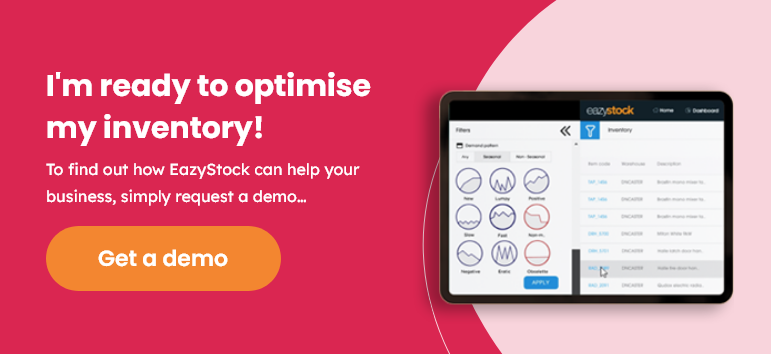
Inventory optimisation software connects to ERPs or inventory systems to automate forecasting. It uses advanced algorithms and machine learning to analyse quantitative data, such as historical sales, trends, seasonality, promotions, and product life cycles, to predict future demand.
The software allows for subjective, expert-level overrides to address market changes and demand shifts. This creates a hybrid quantitative and qualitative forecasting method that considers past trends and potential sales.
Eazystock’s inventory optimisation software automates the qualitative and quantitative forecasting methods. You can see Eazystock in action for free.