What is inventory ROI, and why does it matter for better stock decisions?

When you’re managing inventory, every stock decision has a cost. Hold too much, and you tie up cash in products you may not need. Hold too little, and you risk stockouts, lost sales, and unhappy customers.
That’s where inventory ROI comes in.
Inventory ROI helps you understand whether your stock decisions are paying off. It gives you a simple way to compare the cost of an inventory decision with the value it creates, whether that’s reducing excess stock, improving availability, cutting carrying costs, or freeing up working capital.
When you’re trying to optimise inventory, ROI becomes especially useful. It helps you move beyond gut feel to see which decisions are likely to deliver the best financial return before you commit time, money, or effort.
In this post, we’ll explain what inventory ROI is, when it’s useful, and how to calculate it. By the end, you’ll be able to run a quick ROI check on your own stock decisions.
Return on Investment (ROI): The Basics
What is ROI?
ROI (Return on Investment) is a quick way to measure value for money (profitability relative to cost). It answers the simple question, “If we do this, what do we get back?”
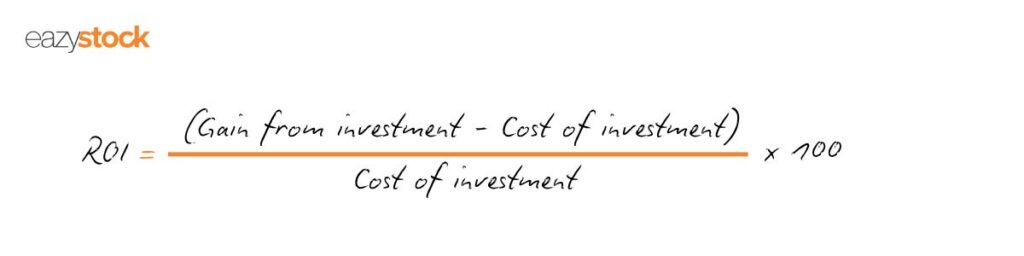
The basic formula looks like this:
In day-to-day inventory purchasing or planning, ROI rises or falls based on your decisions: what service level you’re aiming for, how much buffer (safety stock) you hold, and how you replenish during demand and supply variability. Those decisions will affect measurable operational outcomes (fill rate, stockouts, inventory value, expediting, and obsolescence) that translate into money (gross margin gained, carrying cost saved, and working capital freed). That’s why ROI isn’t only something you calculate afterwards. It’s a great way to pressure-test whether a policy change is worth it before you roll it out.
5 benefits of using ROI for supply chain and inventory management
ROI isn’t just another KPI to report on. Used well, it helps you:
- Make better decisions: It helps remove guesswork and bias so you can choose the best option.
- Improve cost control: It makes the true cost of overstocking, overspending, or under-investing much easier to spot.
- Build a stronger business case: A clear ROI helps you explain the “why” behind your recommendation.
- Support continuous improvement: Tracking ROI over time shows what’s working and what needs adjusting.
- Stay agile in tough markets: Regularly monitoring inventory ROI helps you invest in the right stock and adapt quickly when demand, supply, or costs change.
The 4 supply chain decisions where ROI makes a significant impact
ROI is especially useful when you’re weighing up a supply chain investment, changing a policy, or making a working capital call. Typical “what-if” questions include:
- Investing in tech: ROI can help you clarify which tech improvements (new inventory optimisation software, barcode scanning, ERP upgrades, or warehouse automation) are most likely to pay off.
- Choosing a new supplier: Looking at price, lead time, and reliability together gives you a clearer picture of a supplier’s overall value.
- Revising stock optimisation policies: ROI-backed scenario planning helps check whether the extra sales from increasing safety stock levels will outweigh the extra carrying cost.
- Setting a working capital policy: ROI can show whether cash tied up in inventory would be better spent elsewhere.

When should I review inventory ROI? And how often?
ROI isn’t a one-off calculation you can set and forget. But it also doesn’t need to be reviewed constantly. Monitoring your inventory ROI is most effective when you use it at the right time, which depends on your business goals and industry.
Reviewing your inventory ROI ensures your assumptions remain relevant and that results are going the way you hoped. Keeping on top of it will highlight glitches in time to address them.
Reviewing your inventory ROI is good practice in the following circumstances:
- Before a big stock optimisation investment.
- Quarterly, to ensure that the investment is delivering what you expected.
- Monthly, to track ongoing optimisation projects.
- Any time you’re considering something new (a tool, a supplier, a process change).
- When you’re faced with a choice.
- When there’s market volatility, to understand what tariffs, geopolitics, or sudden demand shifts mean for you, and decide how to respond.
How to calculate inventory ROI
Let’s look at a practical example.
Step 1: Identify the decision
Start by clearly defining your decision. For example, are you:
- Implementing a new inventory optimisation system?
- Increasing stock levels for a high-demand product?
- Automating part of your warehouse?
- Automating for stock visibility?
- Switching to a new supplier?
Quick tip: stick to one decision at a time. If you try to calculate ROI for multiple changes at once, it’s almost impossible to tell what’s driving the result.
Why results vary
Different items tie up different amounts of cash and create different levels of service risk. For A-items, a small improvement in availability can protect revenue and margins while delivering substantial gains. For C-items, the bigger opportunity is usually cost-based, such as reducing unnecessary stock and freeing working capital.
Demand patterns and lead times also affect ROI variability. Erratic or intermittent items with higher forecast errors require more safety stock, so improvements in forecasting and reorder settings can deliver greater benefits than for stable items. Long or volatile lead times drive higher safety stock levels and greater reliance on expensive express orders. Therefore, improving supplier performance or increasing buffers can boost ROI more than with shorter, predictable lead times.
Step 2: Identify gains and costs
Before identifying your gains and costs in detail, you can map the changes you want to make in a table that shows the change, how you’ll measure it, and the financial impact. This gives you a useful starting point for building a more detailed list of the costs and benefits behind each change.
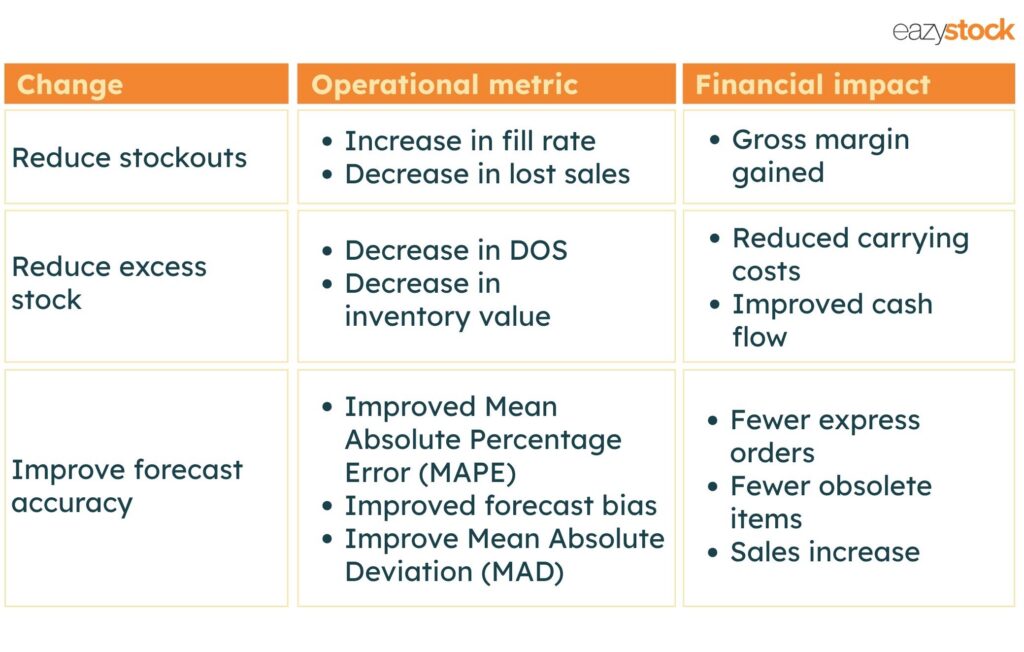
Once you know which change you want to make, list all the quantifiable costs and benefits attributable to that decision. Be as comprehensive and accurate as possible.
Data you’ll typically need from your ERP or WMS
- On-hand stock and stock on order
- Backorders
- Demand and sales history
- Sales price, cost, and gross margin
- Supplier lead time (average and variability)
- MOQs, case sizes and minimum order values
- Stockout proxy (lost sales estimate, backorder lines, substitutions)
- Carrying cost rate components (storage, shrink, insurance, finance)
Not every cost or gain is easy to quantify or attribute to one decision. For example, an investment might improve customer experience, team morale, or brand reputation, which may be harder to quantify in monetary terms.
Common ROI mistakes planners make (and how to avoid them)
If you’re calculating ROI manually, it’s easy to make small mistakes that lead to making the wrong decision with a big impact. Always check that you’re using the right figures to ensure your calculations are accurate and support your decisions.
Common ROI mistakes
- Failing to set clear objectives for the project or decision.
- Changing more than one baseline at a time (mixing service and cost levers).
- Double-counting savings (e.g., counting inventory reduction and the carrying cost saved as two separate gains, or counting revenue increases that would have occurred without the change).
- Incorrectly estimating project costs.
- Using theoretical stockouts instead of actual lost sales and backorders, or overestimating anticipated benefits.
- Forgetting ramp-up costs such as training, data cleansing and ongoing purchaser time.
Inventory ROI: the time factor
Another issue with ROI is time. Don’t forget to consider how time relates to your decision and to set a reasonable period to assess the impact.
Think about:
- Over what period will the costs actually occur?
- When will the gains be realised? Same day? In a week? In a year?
- Is this a one-off or ongoing investment?
- When would your team be up to speed with a new system?

Time is important because an investment decision with a high upfront cost but long-term gain will show low short-term ROI but strong long-term value. If you don’t account for the time factor, you could fail to recognise the long-term gain.
Step 3: Calculate inventory ROI using the ROI formula
In practice, you’ll want to model outcomes across a few realistic scenarios. Below is a worked example with three cases (Conservative, Typical, and Proven) to illustrate how assumptions affect the result.
Let’s use a hypothetical business with these headline numbers:
- Annual revenue £10m
- Inventory value £1.5m
- Initial stockout rate (Lost sales share) 8%
- Gross margin on sales 30%
- Annual carrying cost rate 20%
- Cost of capital (opportunity cost of freed working capital) 8%
Across the three scenarios, we’ll assume the following outcomes:
- Conservative: inventory down 10%, stockouts down 25%
- Typical: inventory down 20%, stockouts down 60%
- Proven: inventory down 30%, stockouts down 80%
For the ROI calculation, we’ll use the following:
- Annual carrying cost savings, because they’re a straightforward year-on-year benefit.
- Freed working capital (from inventory reduction). Some ROI models convert this into an annual benefit using the cost of capital, but we’ll keep it simple here and show it as freed capital.
- Annual recovered sales (not gross profit), to avoid double-counting. In some cases, you might use gross profit instead, especially if the profit uplift comes from more than just recovered sales.
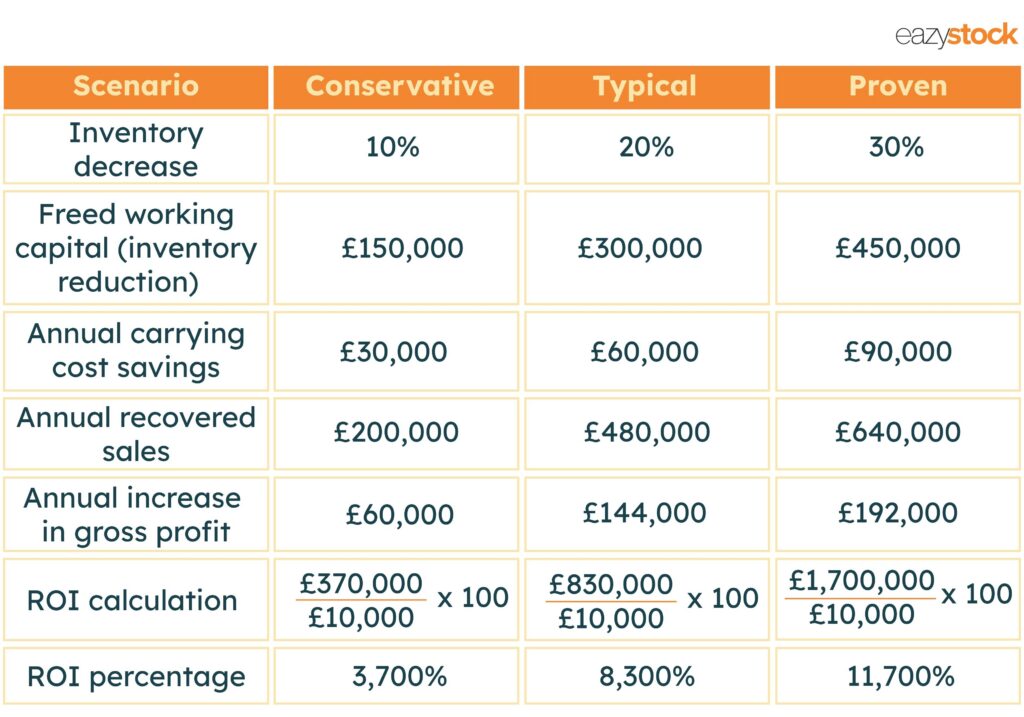
Note: Be careful not to double-count. For example, inventory reduction and carrying cost savings are linked, and recovered sales should be converted to gross profit (not added as revenue).
Limitations
- The simulation applies uniform percentage changes across all SKUs; in practice, results will vary by SKU.
- Recovered sales and gross profit assume immediate conversion and stable margins, which may overstate short-term realised profit.
- Operational savings (labour, dispatch consolidation, and supplier freight) are not included.
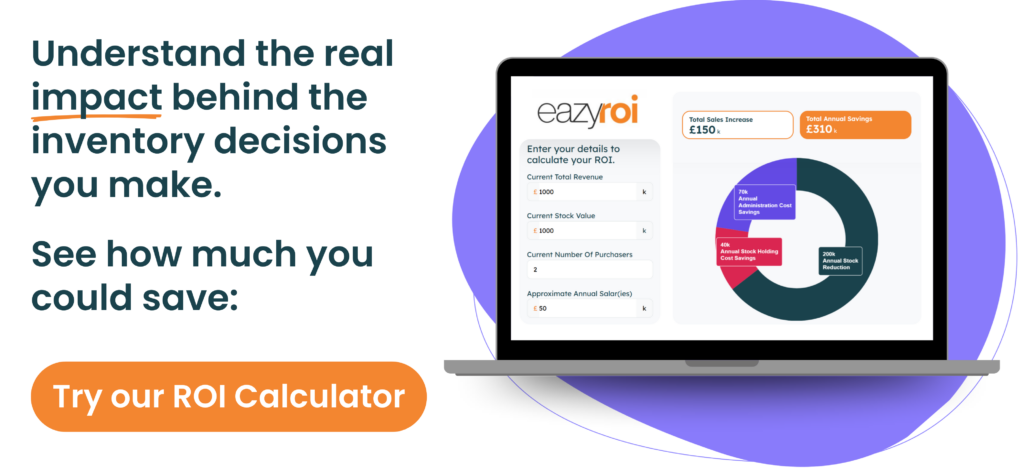
ROI made easy: try our EazyROI inventory optimisation calculator
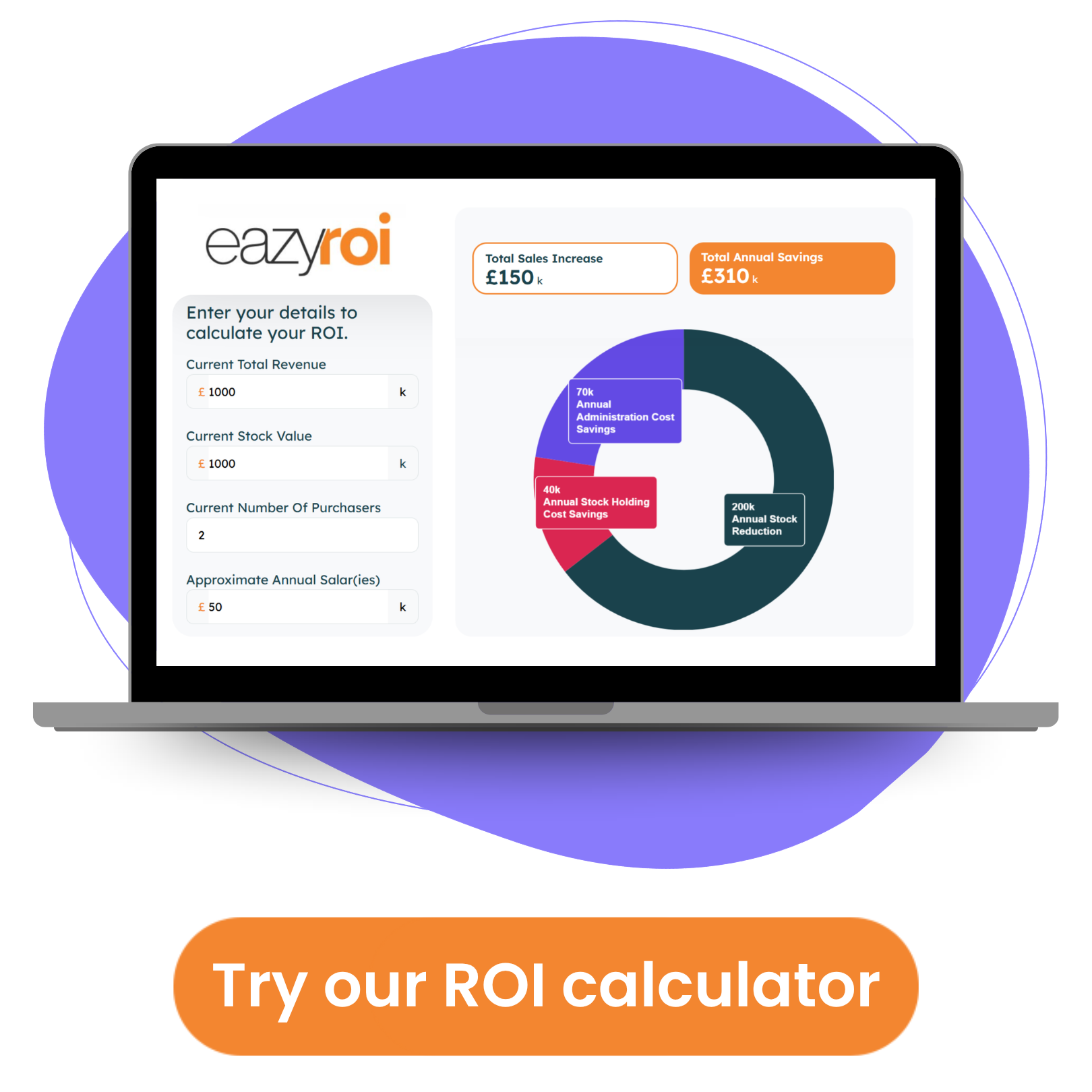
If calculating ROI feels like hard work, we’ve simplified the calculations with the EazyROI ROI calculator. All you need to do is enter your company’s details, and it will immediately calculate the savings you’ll achieve by implementing EazyStock.
If you have any questions about inventory ROI or you would like to know how we can help you improve yours, get in touch. We’re here to help.
ROI FAQs
Inventory ROI is the gain you get from your inventory, relative to the associated buying and holding costs.
To calculate ROI, use the formula:
Inventory ROI = ((Gain from inventory – cost of inventory) / Cost of inventory) x 100
Inventory ROI measures profitability relative to your investment, answering the question, “Is this investment worth it?”
Inventory turnover measures how quickly you sell and replenish your stock, answering the question, “How efficiently am I shifting stock?”
Improve your inventory ROI by tweaking different components of your inventory ecosystem. You might like to try:
- Eliminating dead stock to free up working capital, and reduce storage and insurance costs.
- Improving the accuracy of your forecasts to reduce stockouts.
- Automating replenishment decisions to save staff time and reduce stockouts.
- Negotiating better terms with your suppliers to reduce the cost of stock, delivery, or storage.
- Automating warehousing logistics to reduce delivery and pick times and the number of manual errors.
- Automating orders to ensure you’re buying only what you need of the right stock.
- Automating manual systems to free up staff for more strategic or rewarding work.
- Reducing inventory staff turnover costs by implementing less stressful, more effective systems.
Good inventory ROI depends on context. There’s no universally perfect return-on-investment percentage. It depends on your market, customer expectations, stage of growth, and budget constraints. For instance:
- If you’re a startup, you’ll probably prioritize availability and service levels over ROI.
- If cash flow is restricted, you’ll prioritize fast payback


