
What is the customer order decoupling point – and why does it matter?

Be honest…when considering your supply chain strategy, have you ever felt frustrated by the question: at what point do we stop guessing and start reacting?
If that question sounds familiar, you’re not alone. It’s one of the most common issues in supply chain management: how much to plan and when to wait for actual demand. Get it right, and you’ll find yourself with a self-sustaining supply chain. Get it wrong, and you’ll find yourself alternating between stockouts and excess stock.
The answer to that question lies in understanding your “customer order decoupling point”.

In this blog, we’ll explain the concept of the decoupling point, why it matters, and how different production strategies influence its position.
You’ll learn how to identify your decoupling point, interpret what its position says about your strategy, and determine when to reposition it. By the end, you’ll be able to map where forecasts end and customer demand begins and understand the trade-offs you make.
What is the customer order decoupling point?
Let’s start with a customer order decoupling point definition. The decoupling point is the moment in your supply chain when forecast-driven activity ends, and demand-driven activity begins, and when guesswork turns to certainty. For example, if you produce finished units based on forecasts and ship them as soon as orders arrive, your decoupling point is close to the customer. If you only assemble once an order arrives, your decoupling point is further up the supply chain.
Imagine your production line as a river, flowing from procurement at the top to distribution at the bottom. The decoupling point sits across this river, acting as an inventory dam. It’s the stock that absorbs the uncertainty between early forecasts and the surge in actual customer demand, helping protect service levels and prevent upstream volatility from causing downstream delays.
Everything “upstream” of (before) the decoupling point is driven by forecasts – procuring, manufacturing, and assembling based on what your systems anticipate demand will be. This is known as “push-based supply”, which enables production at scale, lower unit costs, and proactive planning. However, without good data hygiene, you risk stockouts or excess stock.
Actual demand and customer orders trigger everything “downstream” of (after) the decoupling point. With this “pull-based supply”, most work only begins once a formal order is received, reducing the risk of overproduction and enabling greater customisation. The trade-off is that customers might have to wait, and it can be difficult to react to unexpected spikes in demand.

Clearly, each approach has its advantages and disadvantages. That’s why most businesses combine both. The decoupling point is the pivotal moment where these two approaches come together.
Why does the decoupling point matter?
Essentially, supply chains face constant pressure from two directions: push versus pull, upstream versus downstream or forecast versus reality.
On one side of this tension are customers expecting quick delivery, flexibility, and constant availability; on the other side are the business’s needs to control costs, manage cash flow, and keep operations running as seamlessly as possible.
The decoupling point helps manage priorities by balancing customer readiness with streamlined inventories. By strategically deciding where to decouple inventory in your supply chain, you can achieve the following:
- Reduce delivery lead times by holding finished goods closer to the customer distribution point, enabling orders to be fulfilled more quickly.
- Mitigate supply uncertainty by using existing inventory as a buffer against supplier delays or other production disruptions.
- Minimise forecast risk, as the further upstream the decoupling point, the less you commit finished goods to a projection that might ultimately prove wrong.
- Improve responsiveness with a balanced decoupling point that facilitates quicker operation flexibility when production and commercial demands vary.

Considering this, it’s clear that the decoupling point can’t be treated as fixed. Understanding where, when, and how to use it distinguishes businesses that manage their supply chains reactively from those that do so proactively.
Where should the decoupling point sit?
As you can see, there is no universal position for this vital operational funnel. Its placement depends on a combination of factors unique to your business, market, and supply chain strategy. Here are some customer order decoupling point examples that illustrate how their position affects operations in practice.
Make to Stock (MTS)
If demand for your products is stable and predictable, you can afford to hold finished goods for immediate dispatch. In a make-to-stock environment like this, the decoupling point sits as far downstream as possible because customers order from available stock, with replenishment driven by forecasts.
This is effective when products with predictable, high-volume demand need quick delivery. It is less effective when forecasts are inaccurate, for example, if a retailer overestimates the popularity of a batch of summer t-shirts as winter approaches.
Assemble to Order (ATO)
If customers agree to a longer lead time in exchange for a bespoke product, or if demand is more erratic, the decoupling point should move upstream, closer to the component level. This applies to assemble-to-order models, where the final assembly of pre-stocked subassemblies or modules only happens when an order is received.
This best suits businesses that want to offer a degree of variety without needing to stock every possible configuration of a finished product. For instance, Apple has recently made some changes to how customers buy a Mac online, offering even more end-to-end customisation of specifications rather than focusing on fixed-price presets.
Make to Order (MTO)
Essentially, make-to-order means production begins from scratch once a product is confirmed, using the necessary, on-hand raw materials. Those raw materials are at the decoupling point. This approach makes sense under three conditions: products that require significant customisation, customers who are willing to wait, and a prohibitive cost of holding finished goods.
Ordering a desk from a custom furniture maker is probably the most obvious example of made-to-order items. Unlike going to somewhere like IKEA, where you’d buy unassembled, flat-packed components, bespoke designers tend to start production only after receiving an order. The raw wood will be kept in stock, but it won’t be carved or crafted until a client places an order.

Engineer to Order (ETO)
Located at the most upstream end of the decoupling point spectrum, engineer-to-order workflows involve little or no pre-held inventory and therefore do not begin any production until an order is received. From design to procurement, the entire process relies on a continuous relationship and agreement between the manufacturer and the client.
Realistically, this approach is only feasible for complex, high-value projects that require ongoing consultation, such as large-scale infrastructure development demanded by the defence sector, where airtight contracts and significant budgets are formalised before specialist equipment is engineered.
When should you reposition customer order decoupling points?
You’ll know all too well that customer expectations constantly shift, supply chains get disrupted, and markets evolve. All these dynamic factors can make a previously optimal decoupling point feel less appropriate at the drop of a hat. However, the good news is, it doesn’t have to be a case of set-and-forget.
It’s important to review your decoupling point regularly, being mindful that repositioning it will have a knock-on impact on your operations, including production planning, supplier relationships, warehousing strategy and cash flow. Always review your customer order decoupling points when circumstances change, or you face situations such as:
- Changing lead times. Encountering a different supplier with shorter lead times might allow you to move the decoupling point downstream without compromising service.
- New demand patterns. A new product that initially lacked sales data may become more predictable over time, justifying a switch to a make-to-stock model.
- Intensified competition. If rivals begin offering faster delivery, lowering prices, or increasing variety, moving your own decoupling point might be necessary to remain competitive.
The best time to review your decoupling point is before circumstances force you to. If that’s not possible, review it as soon as you notice your supply chain performing differently.
How do you seamlessly decouple inventory?
Choosing the right decoupling point position is one thing; managing the inventory held there is another.
As with any strategic change in your business, the key is to adopt an analytical approach, such as scenario modelling. Scenario modelling assesses how moving the decoupling point impacts stock levels, service quality, costs, and lead times.
Frustratingly, managing this across thousands of SKUs and multiple sites, consolidating data and visibility across the entire operational landscape, is too complex for spreadsheets or manual ERP systems.
That’s where inventory optimisation software comes into play. Instead of applying a blanket replenishment policy across your entire range, these solutions classify items dynamically, considering demand profile, product lifecycle stage, and value, before applying the appropriate forecasting algorithm to each. This ensures the inventory held at your decoupling point is substantial enough to manage uncertainty but lean enough to prevent tying up capital in non-movers.
Inventory optimisation technology helps you align replenishment tactics across multiple points in the supply chain, including warehouses, distribution centres, and manufacturing sites, without treating each SKU the same. This helps with assemble-to-order or make-to-order strategies, where the transition from components to finished products influences service levels.
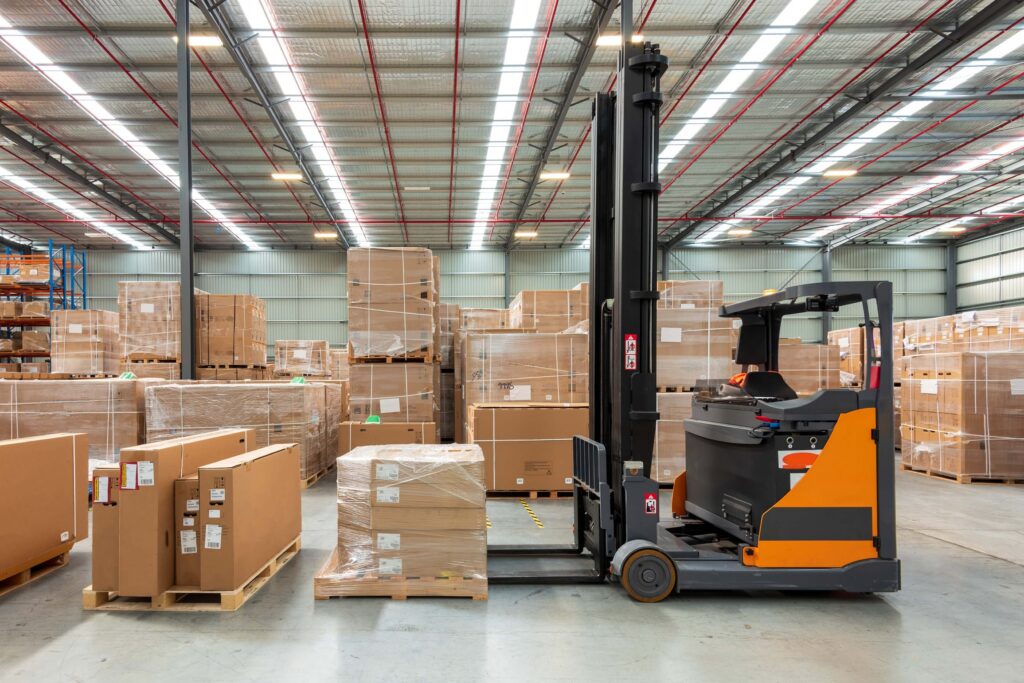
Essentially, inventory optimisation software turns theory into practice by ensuring the decoupling point is correctly positioned to benefit your supply chain strategy.
Summary
The decoupling point is a critical yet often overlooked strategic choice in supply chain management. It defines where your operation pivots from planning to responding, when to hold inventory, and ultimately how effectively you can serve customers while still minimising costs.
That’s why understanding exactly what the decoupling point is, why it sits where it does, and whether it’s still in the correct place is a valuable exercise for any supply chain leader. In an unpredictable and fragile manufacturing landscape, businesses that manage their decoupling point deliberately will consistently outperform those that rely on static, reactive models.
Speak to our experts to find out how EazyStock inventory optimisation software can help you improve your forecast accuracy to support your customer order decoupling point strategy.

Customer order decoupling point FAQs
The decoupling point acts as the boundary between forecast-driven and demand-driven activities in a supply chain. Its primary purpose is to enable a business to hold inventory at a strategic location to absorb uncertainties in supply and demand. It can also be used to reduce customer lead times and balance service levels against inventory costs.
Key factors include the predictability of customer demand, the delivery time customers are willing to accept, the complexity and customisability of the product, production lead times, the cost and risk of holding inventory in varying states, and the broader operational strategy of a business.
Safety stock is a contingency of materials or finished goods stored to protect against variances in demand or supply. Decoupled inventory is stock that separates upstream and downstream operations at a strategic decoupling point somewhere along the manufacturing process. In practice, inventory held at the decoupling point often includes safety stock.
Failing to establish a deliberate decoupling point strategy forces businesses to rely on inconsistent, ad hoc inventory management, which risks holding stock in the wrong form, place, or quantity. This typically culminates in excess inventory or unwanted stockouts, making it difficult to respond to supply disruptions or shifting demands.
Yes. In fact, for many businesses, the decoupling point should evolve in response to market conditions, customer expectations, and operational capabilities. While repositioning the decoupling point requires careful analysis of potential impact, inventory optimisation software can support this process by modelling different scenarios before implementing structural changes.
Postponement is a supply chain tactic that intentionally delays the final configuration of a product until as late in the process as possible, effectively pushing the decoupling point further downstream. By keeping products in a generic or partially finished state for longer, businesses can meet a wider range of customer requirements from a smaller inventory base.