Can generative AI really manage your inventory?

In the first blog in this series, we looked at where generative AI can genuinely help supply chain and purchasing teams. Used well, it can save time, simplify complex information and make communication easier across the business. However, support isn’t the same as control.
When it comes to inventory management, things get trickier. Ask a tool like ChatGPT to explain safety stock, reorder points or demand forecasting, and it can give you a helpful starting point. Inventory management depends on repeatable decisions, live data, supplier constraints, forecasting logic and a clear understanding of service levels, stock targets and working capital. These are not areas where a convincing one-off answer is enough.
This is why, when we’re asked whether generative AI can truly manage inventory, the short answer is no. Generative AI can support inventory teams, but it cannot safely replace the structured forecasting, replenishment logic, supplier order proposals and system integration that effective inventory management depends on.

In this blog, we examine the risks of relying on generative AI for inventory management decisions, and how they can quickly lead to excess stock, stockouts and poor purchasing decisions.
Why the AI hype is understandable
It’s easy to see why people are asking whether AI can manage inventory. Businesses are seeking to improve inventory management processes in the most cost-effective way. AI is an attractive option because it’s low-cost, and many AI tools process information quickly and respond in plain English. That makes them appealing to teams juggling supplier emails, planning reports, meeting notes, order queries and internal updates.
Generative AI can be a brilliant assistant for communication, explanation or first-pass analysis – I use it regularly throughout the day. It can turn a supplier update into a clear action list, explain forecast error to a non-technical audience, or help create training notes for new starters.
Those use cases are valuable because they reduce team admin and improve collaboration, but they still sit around the planning process; they don’t replace the planning process itself.
Where generative AI can help with inventory management
When used correctly, generative AI can make inventory-related work faster, clearer and easier to share. It can help teams:
- Explain inventory concepts such as safety stock, reorder points, ABC analysis and inventory turnover in simple terms.
- Draft supplier emails, escalation messages, internal updates and meeting summaries.
- Summarize reports so that different teams can understand the key risks, actions, and commercial impact.
- Turn process notes into training guides, FAQs and checklists.
- Explore scenarios by helping teams structure questions, assumptions and discussion points.
- Highlight themes in unstructured information, such as supplier updates, customer feedback, or meeting notes.
By helping people understand, communicate, and investigate inventory information, AI saves time and improves collaboration, especially when teams work with large volumes of data, documents, and conversations.

The catch is that these use cases still need human review and reliable source data. While AI can support the process, the problem starts when AI moves from helping people understand information to making operational recommendations that affect stock, service and cash.
Why AI alone cannot manage inventory reliably
Inventory management is not about getting a one-off plausible answer. It’s about making repeatable, trusted decisions using live data, validated rules and a clear view of your business operations.
A generic AI tool doesn’t automatically know your supplier constraints, minimum order quantities, service-level targets, seasonal demand patterns, product lifecycle stages, substitutions, warehouse rules or cash-flow pressures. It may help you think through those factors, but it doesn’t continuously apply them across your inventory.
That creates four big risks:
1. Insufficient forecasting logic leading to stock issues
Demand forecasting needs more than a quick prompt. It depends on historical demand, seasonality, trends, volatility, intermittent demand, promotions, lost sales and exceptions. It also needs adaptable forecasting algorithms that respond to changes in demand profiles. A one-off AI response may explain a forecasting method or interpret a report. It might also provide a one-off forecast based on a data snapshot, but it will not deliver a controlled, repeatable forecasting process across your full product range. This means supply won’t match demand, resulting in overstocks of some items and under-stocks of others.
It’s worth pausing here, as this is where the phrase ‘AI forecast’ can be confusing. A large language model, or LLM, is designed to predict the next likely word or response in a conversation. It’s brilliant at explaining patterns, summarizing information and helping people ask better questions, but that’s not the same as forecasting future demand.
A machine-learning forecast works differently. Most inventory optimization software incorporates machine-learning forecasts. These forecasts are trained on demand data and look for repeatable patterns such as trends, seasonality, volatility and intermittent demand. In inventory planning, they also need to be tested, monitored and updated as new sales, stock and supplier information becomes available.
So, if you ask a generic AI tool, ‘Here are my sales, predict next week’s demand,’ you may get an answer that sounds sensible. The problem is that the tool is not automatically connected to your live demand history, product hierarchy, supplier lead times, stock policies or exception rules. Without that structure, it can behave more like a helpful commentator than a reliable planning engine.
2. One-off replenishment recommendations leading to expensive errors
Replenishment is where small errors become costly. The right order quantity depends on the lead time, demand variation, order frequency, target service level, stock on hand, stock on order, backorders, pack sizes, and supplier constraints. Generative AI can explain these inputs, but, again, it’s not designed to keep recalculating them as conditions change. You would need to update and reload your data daily to get new recommendations, which complicates the process and increases administrative time.

3. One-off replenishment recommendations leading to expensive errors
Your ERP holds essential operational data, but generative AI doesn’t connect to it in a governed, reliable way. Instead, you’re relying on buyers uploading large datasets or copying and pasting data into the AI software to form prompts. These prompts can create security concerns, version-control issues, and extra manual work. It also means the output is only as current as the data you provided.
4. Inaccurate supplier order proposals
Purchasing teams need practical order proposals they can review, adjust and place with confidence. These proposals must reflect latest demand, supplier rules, stock targets and business priorities. A generic AI response may look convincing, but if the logic is unclear or the data is incomplete or out of date, buyers have no reliable basis to act on it.
These risks all point to the same issue: AI provides information at a single point in time, rather than continuously reviewing live data and alerting teams to changes. If it relies on incomplete data, outdated information, or manually uploaded spreadsheets, the workflow becomes fragile, error-prone and unnecessarily lengthy.
That can lead to familiar inventory management problems: too much cash tied up in excess stock, stockouts of critical items, urgent supplier escalations, poor service levels and reduced confidence in planning outputs. Trusted information is essential because inventory teams need to understand where recommendations come from, how they were calculated and whether they reflect the latest operational data.
The difference between AI assistance and inventory optimization software
A simple way to distinguish between the two is to ask whether the task needs explanation or execution.
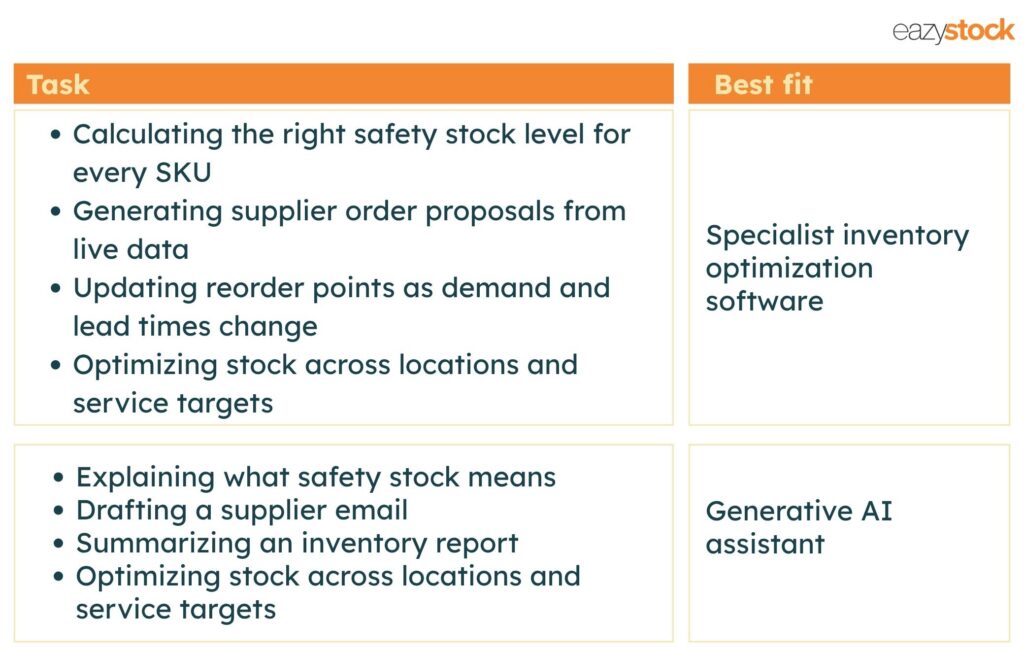
As you can see, both have a role. Generative AI helps teams move faster, explain information more clearly and reduce admin. Specialist software is essential when the business needs consistent, auditable and actionable planning recommendations.
A safer way to use AI for inventory management
The best approach is to give AI the right job.
Use specialist inventory optimization software for structured tasks: forecasting demand, calculating safety stock, optimizing reorder points, generating purchase recommendations, and connecting to ERP data.
Use generative AI to support the people involved in that process by helping them explain, communicate, document, and investigate information more quickly.
This gives teams the best of both worlds. Planning decisions stay grounded in reliable data and purpose-built logic, while AI removes friction from everyday communication and analysis.
If AI is not the right tool to own forecasting, replenishment and purchasing decisions, the obvious next question is: what is?
In the next blog, we look at why specialist inventory optimization software is better suited to the job and how it provides teams with the structure, integration, and repeatability that generic AI cannot provide on its own.
Where EazyStock fits
EazyStock is built for the inventory decisions that generic AI should not make on its own. It integrates with ERP and business systems, applies specialized inventory optimization logic, and helps purchasing teams generate practical replenishment recommendations.
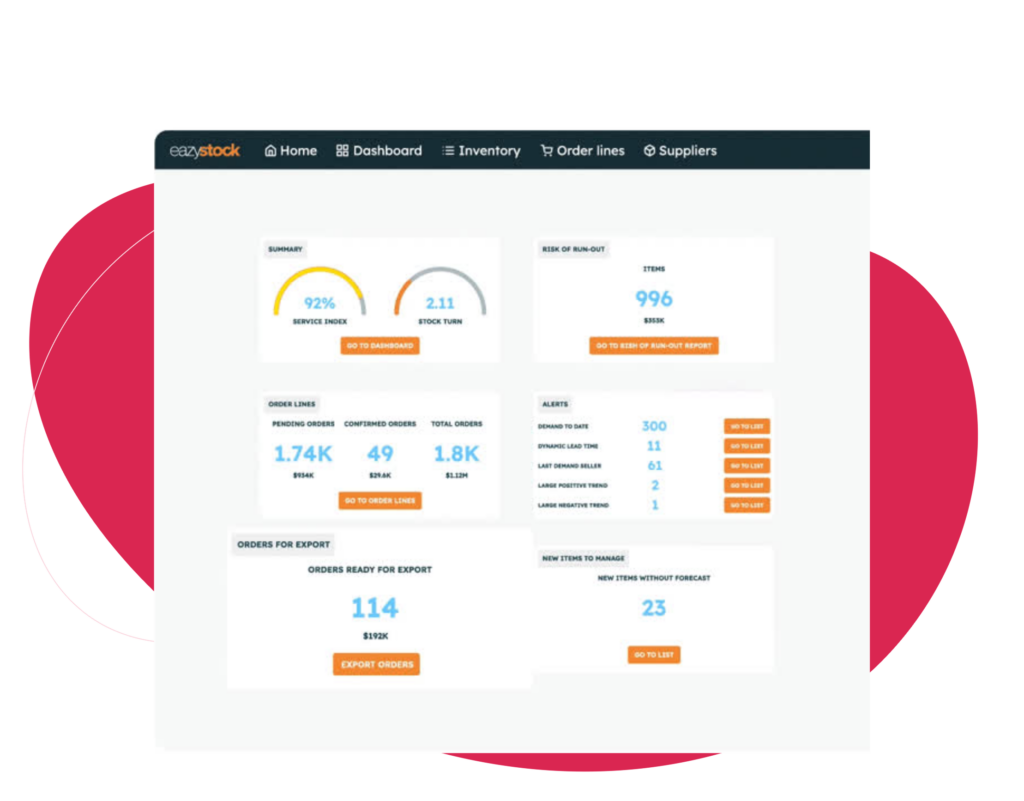
That helps teams improve forecast accuracy, reduce excess stock, avoid stockouts, and make more confident supplier ordering decisions without relying on ad hoc prompts or manual spreadsheet work.
If you’re ready to explore a more reliable way to manage your inventory, speak to the EazyStock team to see how specialist inventory optimization software can help you make better replenishment decisions using the data you already have.
Part of our AI and inventory optimization series:
We’re exploring where generative AI supports supply chain teams, where it falls short, and how specialist inventory optimization software helps businesses make better planning and purchasing decisions.
FAQs: Can AI manage inventory?
No. AI cannot reliably manage inventory. Instead, it can support inventory management by helping teams analyze information, summarize reports, explain concepts, and improve communication. It should not be treated as a complete replacement for inventory optimization software, as reliable inventory management requires live data, planning rules, ERP integration, and repeatable calculations.
ChatGPT can help with inventory-related tasks such as drafting supplier emails, explaining reports, creating training materials, and summarizing information. It can be useful as an assistant, but it should not be used to make forecasting, replenishment, or purchasing decisions without specialist software and human review.
AI outputs are only as reliable as the data, rules, and context underpinning them. Generic AI tools can produce useful summaries and explanations, but accurate inventory planning depends on live and structured data, forecasting methods, supplier constraints, and a clear understanding of service levels, stock targets, and working capital.
Generative AI is designed to create and explain content from prompts. Inventory optimization software is designed to calculate forecasts, safety stock, reorder points, and replenishment recommendations using business data and planning logic. They can work well together, but they address different problems.
No. Businesses should use AI alongside specialist inventory management or inventory optimization software, not instead of it. AI can help teams work faster and communicate more clearly, while specialist software provides the structure, integration, and repeatable logic needed for reliable inventory decisions.