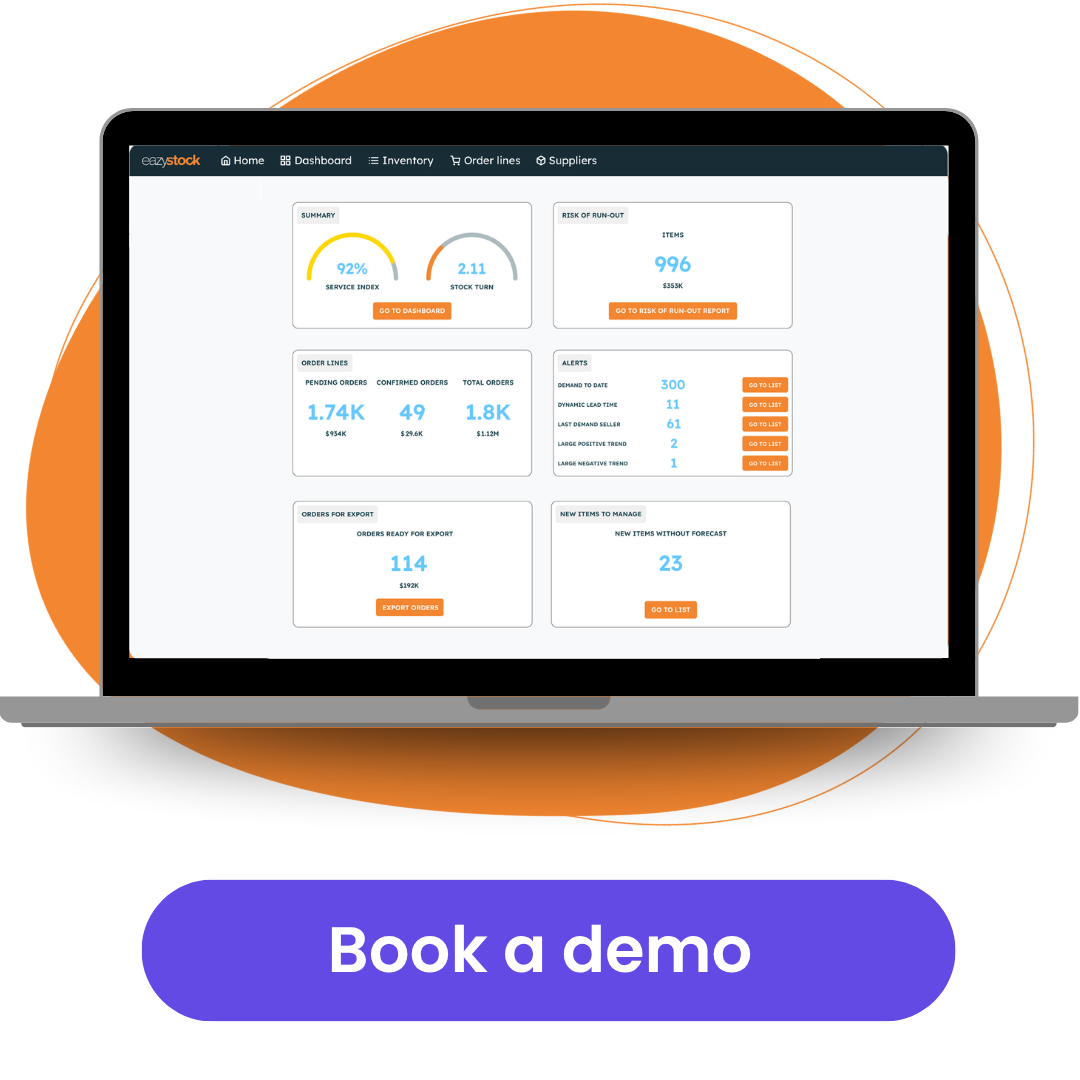
What does inventory optimization actually look like in practice?

Throughout this series, we’ve explored where generative AI can help supply chain and purchasing teams, where it falls short, and why specialist inventory optimization software is better suited to the decisions that affect stock, service, and cash.
Now it’s time to make that practical.
For planners and buyers, inventory optimization isn’t an abstract concept; it changes how teams work day to day. Instead of exporting spreadsheets, checking static rules, and reacting to stock problems after they happen, teams can work with live data, automated calculations, and clear supplier order proposals.
The result is a more structured planning process: one that helps teams forecast demand, set stock levels, calculate replenishment needs, and make purchasing decisions with greater confidence.
In this final blog in the series, we’ll walk through what inventory optimization looks like in practice, from raw ERP data through to daily order recommendations and continuous updates.
Starts with accurate data, not assumptions
The process starts before any forecast, calculation, or order recommendation. It starts with the data your decisions depend on.
Regardless of how you’re managing your inventory, everything begins with your ERP data. It’s essential to have a clear dashboard that provides basic information as a starting point. This includes:
- Sales history
- Stock on hand
- Stock on order
- Supplier lead times
- Purchase history
Getting the right data might not seem important, but every decision you make is based on it. If that data is inaccurate, your decisions will be too. It’s worth spending the time to get the data right so the software can do its job. When you choose your inventory optimization software provider, choose one that includes getting the data right as part of the onboarding. This way, you won’t have to figure it out on your own; you’ll have expert advice and support to ensure it’s right and make the process easier.
Instead of exporting spreadsheets and working with disconnected files, inventory optimization software continuously pulls and structures this data.
That’s an important shift. Rather than working with snapshots, you’re working with a live view of your inventory. The inventory optimization software then automates your calculations and reporting. This is where many businesses see their first win. They spend less time gathering and reconciling data, freeing up time to make strategic decisions.
Step 1: Forecasting demand properly
Once the data is in place, the first real task is to produce accurate demand forecasts. That might sound simple; look at past sales and predict what happens next.
It’s far more complex. Different products behave in different ways. Some have stable demand, while others are seasonal. Some spike unexpectedly, while others sell intermittently, with long gaps between orders. If you’re treating all items the same for forecasting, your stock levels won’t align with demand.
The best forecasts combine three simple steps:
- Look backward – reviewing past sales is helpful when the data is interpreted correctly. Rather than looking only at sales figures, it’s essential to highlight peaks and troughs and check for seasonal patterns. You also need to check for anomalies or outliers to determine whether they are one-offs or should be included in future forecasts.
- Look ahead – while you can’t predict the future, you will know if there are any key events that could affect demand, such as seasonal changes, supplier shutdowns, promotions, or new product launches.
- Use experience – data can show patterns, but your experience will help you sense-check the data to improve forecast accuracy.
Inventory optimization accounts for this by:
- Identifying and applying proper machine-learning driven forecasts
- Identifying demand patterns at SKU level
- Recognizing seasonal demand patterns
- Flagging anomalies and outliers for investigation
- Applying appropriate forecasting models
- Adjusting as demand changes over time
The result is a forecast that reflects actual demand for each product, rather than an inaccurate, one-size-fits-all approach.

Step 2: Setting service levels and safety stock
A good forecast tells you what might happen next. The next step is to decide how much stock you need to meet that demand without tying up more cash than necessary.
When it comes to replenishment, as with forecasting, not every item should be treated the same. Some products are critical to revenue or customer service, whereas others are less important.
Inventory optimization software helps you define:
- Target service levels
- Stocking policies
- The importance of each item to the business (ABC/XYZ)
From there, it calculates safety stock.
This is where most manual planning falls short. Safety stock is often set once and left unchanged, even as demand and lead times shift. With optimization, safety stock becomes dynamic, with updates based on demand variability, lead-time reliability, and service targets. This means you always hold enough stock to meet demand without carrying excess.
Step 3: Translating forecasts into replenishment decisions
Once demand and stock targets are clear, the process shifts from planning to action. As your forecast on its own doesn’t tell you what to do, you need to translate it into clear rules for when to reorder and in what quantities.
Inventory optimization software makes your forecasts more useful by automating reorder points, order quantities, and review periods, and continuously updating them with the latest data. The software also applies real-world constraints, such as supplier minimum order quantities (MOQs) or minimum order values, pack sizes, supplier lead times, and order frequency.
This saves time and reduces the need to gather information from multiple error-prone sources and to carry out manual calculations.
Step 4: Generating supplier order proposals
The next step is to generate order proposals based on demand, stock levels, and replenishment rules. These proposals explain what to order, when to order it, and how much to buy.
This is where optimization is particularly useful for busy purchasing teams. Instead of manually building every order from scratch, buyers can start from clear, data-led recommendations.

When there are shortfalls in meeting MOQs or filling shipping containers, the order fill-up functionality will suggest items with upcoming demand so you don’t fill them with random items that might not sell.
Step 5: Continuous recalculation and updates
The biggest difference is that optimization is not a one-off exercise. It keeps adjusting as the business changes.
For example, whenever demand changes, supplier lead times shift, stock levels fluctuate, or new products are introduced, the system automatically recalculates forecasts, safety stock, and order proposals.
This avoids one of the biggest risks in inventory management: working with outdated assumptions. Rather than working from old data, the calculations update as conditions change, ensuring decisions are based on the most accurate and appropriate information.
Step 6: Visibility and trust
For any planning process to work, people need to trust its outputs. Rather than pulling information from multiple error-prone sources, inventory optimization software provides visibility into performance metrics, serving as a single source of truth. It also makes the logic behind recommendations clear and applies consistent rules across teams.
That means planners and buyers can understand why a recommendation was made, the assumptions behind it, and how it aligns with service and cost targets. This shared framework removes guesswork and makes planning easier to scale.
Where generative AI fits alongside this
Inventory optimization isn’t about a single calculation or tool. It’s a continuous process that aligns demand, supply, and business priorities. By combining accurate forecasting, dynamic safety stock levels, structured replenishment rules, and automated order proposals, you turn complex data into practical actions that teams can rely on.
That’s why it delivers more consistent results than manual planning or one-off AI prompts. It’s designed to run continuously, adapt to change, and support operational decision-making.
Generative AI can still add value here, but its role is different. It should sit around the optimization process, helping people understand, explain, and communicate the outputs more easily.
Inventory optimization software calculates the decision; AI helps people understand and communicate it. Used together in the right way, they facilitate more accurate and easier inventory management.
What could this look like for your team?
When you put all this together, the biggest shift isn’t just better calculations or inventory levels; it’s a more efficient team.
Inventory optimization provides purchasing and supply chain teams with a more reliable way to plan. It integrates ERP data, forecasting, safety stock, replenishment rules, and supplier order proposals into a single structured process.
That means less time spent chasing spreadsheets, fewer reactive decisions, and greater confidence in what to order, when to order it, and why.
EazyStock is designed to make this process simple and practical for real purchasing teams. It connects to your ERP, automates forecasting and replenishment, and provides buyers with clear, practical order recommendations based on live data. When it comes to onboarding, a dedicated customer success manager will work with you to get your data in order so you can trust your outputs from the start.
Another key EazyStock feature is the ability to apply purchasing rules and budgets across a broad range of SKUs. This isn’t true of all software, as some can’t operate at the aggregate level.
If you’d like to see how inventory optimization could work for your business, get in touch with the EazyStock team for a demo.
Part of our AI and inventory optimization series:
We’re exploring where generative AI supports supply chain teams, where it falls short, and how specialist inventory optimization software helps businesses make better planning and purchasing decisions.
FAQs
Inventory optimisation software automates the calculation of demand forecasts, safety stock, reorder points and replenishment recommendations using your business data. Rather than looking at single points in time, it updates calculations in response to market fluctuations. It helps ensure you have the right stock available while minimising costs and excess inventory.
Inventory management focuses on tracking and handling stock. Inventory optimisation focuses on determining what to order, when and how much, using advanced forecasting and planning logic.
Effective inventory optimisation is continuous. Forecasts and replenishment calculations should be updated regularly as demand, stock levels, and supply conditions change.
No. AI can support communication, analysis and reporting, but inventory optimisation relies on structured data, planning rules and continuous calculations that require specialist software.