
De EOQ-formule uitgelegd: wat is het en waarom bestaat het?

EOQ staat voor Economic Order Quantity: de bestelhoeveelheid waarbij de totale kosten van bestellen en voorraad houden het laagst zijn.
Elke inkoper kent het gevoel: je plaatst een bestelling, en achteraf vraag je je af of je niet te veel of te weinig hebt besteld. De EOQ-formule belooft daar een antwoord op te geven. Maar wat berekent de formule precies, en waar liggen de grenzen?
Twee kosten die elkaar tegenwerken

De formule zoekt het punt waarop je totale voorraadkosten het laagst zijn. Daarvoor balanceert ze twee kostenposten die elkaar tegenwerken.
Bestelkosten ontstaan elke keer dat je een order plaatst: het aanmaken van de inkooporder, de verwerking, het ontvangen en controleren van de goederen. Die kosten maak je ongeacht de ordergrootte. Hoe vaker je bestelt, hoe hoger ze oplopen.
Voorraadkosten zijn de kosten voor het aanhouden van voorraad: opslagruimte, verzekering, kapitaalbeslag en het risico op veroudering. Hoe meer je op voorraad houdt, hoe hoger die kosten worden.
De EOQ, ook wel de Wilson-formule genoemd, berekent het punt waarop beide kosten samen het laagst zijn.

Een rekenvoorbeeld
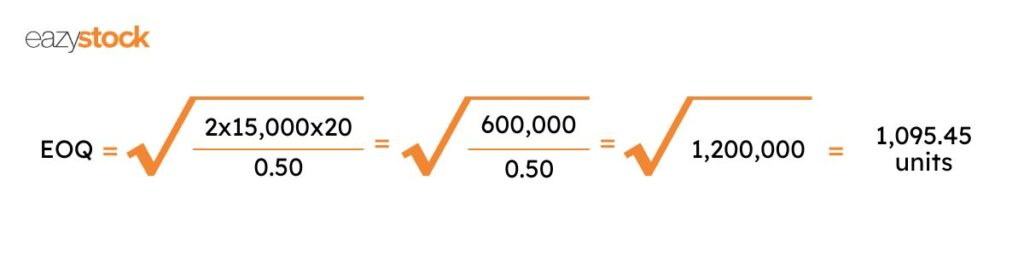
Stel dat je een speelgoedgroothandel bent en een van je hardlopers is een tol.
- Jaarlijkse vraag: 15.000 stuks
- Kosten per bestelling: €20
- Voorraadkosten per stuk: €0,50
Met de Wilson-formule kom je uit op een EOQ van ongeveer 1.096 stuks per bestelling. Bij een jaarlijkse vraag van 15.000 stuks betekent dat ongeveer 14 bestellingen per jaar. Netjes. Maar dan begint het.
Wanneer werkt de EOQ-formule niet?
De formule werkt alleen goed als de wereld zich gedraagt zoals de berekening verwacht. En dat is zelden het geval.
De EOQ gaat ervan uit dat de vraag het hele jaar stabiel is. Voor een speelgoedgroothandel is dat al meteen een probleem: de vraag naar tollen in het vierde kwartaal is een heel andere dan in februari. Wie puur op EOQ bestelt, koopt structureel te weinig in het najaar en te veel in het voorjaar.
Daarnaast houdt de formule geen rekening met variabele levertijden, minimum bestelhoeveelheden bij leveranciers of het verschil in waarde en belang tussen artikelen. Je A-artikelen verdienen een andere aanpak dan je C-artikelen. De ABC- en XYZ-analyse helpt daarbij.
Bruikbaar als startpunt
De EOQ-formule, ook wel gebruikt als basis voor het berekenen van de optimale bestelhoeveelheid, is waardevol als je de basislogica van voorraadkosten wilt begrijpen. Als beslissingsmodel voor dagelijkse voorraadplanning in een groeiend bedrijf schiet het tekort.
Wil je weten hoe je van deze theorie naar een werkende voorraadplanning komt? Dat bespreken we in EOQ in de praktijk: van Excel naar geautomatiseerde voorraadplanning.
Meer weten over voorraadbeheer in Business Central? Download de whitepaper Voorraadbeheer in Microsoft Dynamics 365 Business Central.
FAQs about economic order quantity (EOQ) formula
The economic order quantity (EOQ) is the most cost-efficient stock ordering method because it determines the order quantity that minimizes total inventory holding and ordering costs.
The EOQ is important because it minimizes inventory costs and reduces the amount of capital tied up in inventory, thereby improving cash flow. Companies can reduce excess stock, prevent stockouts, and improve customer satisfaction while maximizing warehouse efficiency.
The EOQ formula is also known as the Wilson formula.
The Economic Order Quantity (EOQ) is the square root of ((2 x Demand per year x cost per order)/cost of holding per unit of inventory).
The EOQ reduces total inventory costs by identifying the order level that minimizes the sum of inventory holding and ordering costs. As it prevents over- and understocking, it minimizes further expenses, such as lost sales or additional holding costs.
Ordering and holding costs are two of the biggest expenses in inventory management. In the EOQ model, there is an inverse trade-off: as the order quantity increases, ordering costs decrease, but holding costs increase.
Where there are smaller, more frequent orders, ordering costs increase while holding costs decrease. The EOQ is the point at which the two costs are equal to minimize total cost.
Annual holding costs = (order quantity/2) x annual holding cost per unit.
The annual holding cost per unit comprises storage, capital, service, and risk costs, such as depreciation, obsolescence, and shrinkage. Add these together and divide by the average number of inventory units.
The EOQ model assumes a constant, known demand rate. When demand fluctuates, the EOQ cannot accurately balance holding and ordering costs, which can lead to stockouts or excess inventory. The EOQ only tells you how much to order, not when, so this will affect reordering.
For items with volatile demand, it’s better to use advanced models that account for demand variability and probability. To keep the calculation accurate, integrate safety stock and use dynamic reordering.
The EOQ assumes a constant, known demand rate, fixed reorder points, fixed ordering and holding costs, no stockouts, constant unit prices, fixed lead times, and one-batch delivery.
The Economic Order Quantity (EOQ) is a calculation that aims to minimize costs, whereas the Minimum Order Quantity (MOQ) is a minimum order quantity imposed by a supplier, which is out of a company’s control.
While the EOQ aims to reduce excess stock, minimize costs, and improve stock availability, the MOQ can lead to inefficient orders that increase excess stock and inventory costs. The EOQ can help to identify uneconomical MOQs.
While there isn’t a set schedule for recalculating EOQ, as it depends on company and industry factors, quarterly recalculations provide a good basis. However, you might need to adjust this depending on industry volatility, product lifecycles, or seasonal demand.
You should also recalculate EOQs when you see significant demand changes, suppliers change their prices, whether for inventory or shipping, if holding costs increase, and as products move through their product lifecycle. It’s essential to recalculate EOQs regularly to avoid stockouts or excess stock.
Combining ROP with EOQ creates a balanced, automated inventory system. As the EOQ only calculates the optimal order point of how much to order, adding the ROP will tell you when to place the order. This rounded inventory view minimizes costs while ensuring stock availability when needed.
The EOQ becomes inaccurate during supply chain disruptions because it assumes constant demand and stable, predictable lead times and costs, which aren’t true during disruptions.
Without regular recalculations, there is a risk of stockouts, increased inventory costs, limited cash flow, missed sales, excess stock, and unsatisfied customers.


