4 reasons for carrying safety stock

You might be a manufacturer working on an order when you realize you’re out of a necessary component due to a sudden increase in demand. You can’t finish the order until you’ve placed the order and received that part, which delays customer delivery.
Maybe you’re a distributor who received a regular order from a customer, only to find that your supplier is experiencing unexpected, longer-than-usual lead times. This means you can’t fulfill your customer orders on time.
In both cases, customer service levels are negatively impacted by a challenge that could have been prevented by carrying safety stock.
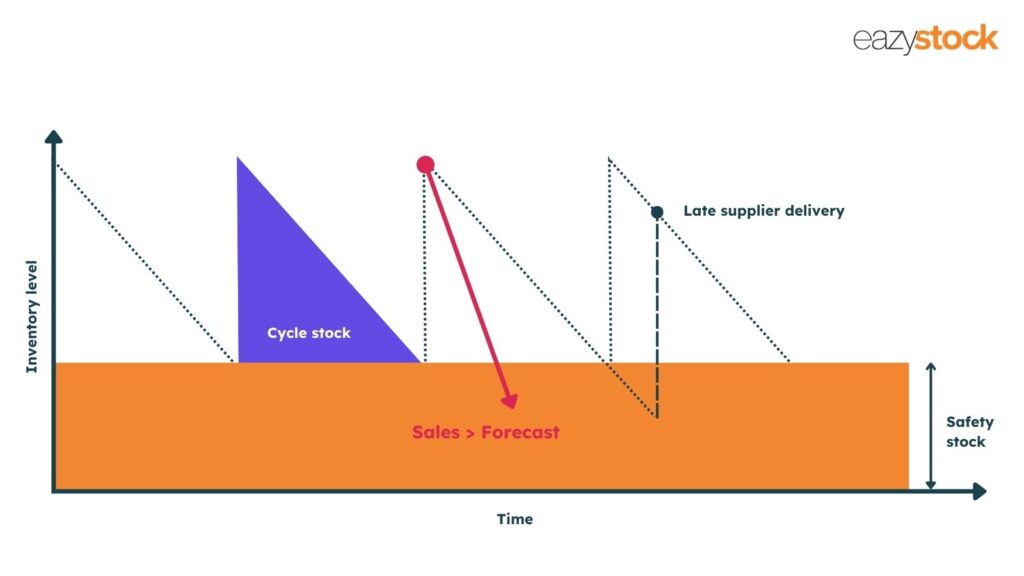
Safety stock, sometimes called buffer stock, is the extra level of stock carried to mitigate the risk of run-out for raw materials or finished goods due to uncertainties in supply or demand. Safety stock ensures that, once you’ve run through your cycle stock (what you expect to sell during a specific period), you can fulfil orders, even if there is an unexpected change in demand or supply.
To maintain high customer service levels, it’s essential to calculate and use accurate safety stock requirements. Using a trial-and-error strategy or a rule-based approach to cycle stock and safety stock results in stock imbalances.
Unfortunately, rules-based approaches tend to be a “one-size-fits-all” approach to inventory management, for example, holding a certain number of weeks of historical average demand, such as four weeks of cycle stock and two weeks of safety stock.
While the “one-size-fits-all” rule will deliver the right amount of inventory for some items, it will deliver too much or too little to meet service levels for others. These inventory imbalances simultaneously result in excessive inventory costs, impeded cash flow, and poor or inconsistent service levels. They are also only sensitive to demand changes, not supply disruption.
4 primary reasons for carrying safety stock
Safety stock is more than just a nice-to-have; it’s a necessity. Here are four key reasons why even small- and mid-sized businesses should carry safety stock.
1. Safety stock protects against unforeseen supply chain disruption
Supply chains are longer and more globalized, with more forces causing disruptions than ever before. If your supplier unexpectedly closes for a week or there is a disruption to delivery, safety stock allows you to continue to fulfil orders.
2. Safety stock compensates for forecast inaccuracies (when demand exceeds the forecast)
If you have consistent demand for a certain item, but in one month you experience a surge in demand and sell more than your forecast, safety stock will cover this without sacrificing your customer service level during replenishment.
3. Safety stock prevents disruptions in manufacturing or deliveries
Safety stock helps maintain high customer service levels and a smooth supply chain. It reduces stress and administrative time for your teams. Instead of running around trying to locate and reorder parts, they can focus on fulfilling customer orders.
4. Safety stock helps avoid stockouts to maintain high customer service and satisfaction levels
Safety stock’s real goal is to keep customers happy. While safety stock helps with the smooth running of your warehouse and supply chain, the end goal is to ensure customer satisfaction and keep them coming back.
However, since each SKU in your inventory has a unique demand pattern, you need to adjust your safety stock levels accordingly. Safety stock requires a tailored approach that considers more factors than. rule-based approaches offer. For example, accurate safety stock levels include service levels, forecast accuracy, and lead time variability.
A sound, mathematical approach to safety stock calculations not only justifies the required inventory levels to business leaders, but also balances the conflicting goals of maximizing customer service and minimizing inventory costs.
Learn more
To understand best practices for calculating safety stock for your business, download our free eGuide “How to calculate safety stock for inventory management”.
If you’d like to discuss how EazyStock can support your business with automated safety stock calculations, contact our expert team or request a demo.
This post was first published in March 2022 and updated in January 2026
FAQs about importance of carrying safety stock
Safety stock, sometimes called buffer stock, is the extra level of stock carried to mitigate the risk of run-out for raw materials or finished goods due to uncertainties in supply or demand.
Safety stock ensures that, once you’ve run through your cycle stock (what you expect to sell during a specific period), you can fulfil orders, even with unexpected demand or supply changes.
- Cycle stock is the amount you expect to sell, based on your demand forecasts.
- Safety stock is additional stock kept to cover unexpected demand or supply changes after you have sold the cycle stock.
While cycle stock is expected to sell, there should always be a level of safety stock kept in reserve.
Supply chains are longer and more globalized, with more forces than ever before causing disruptions. If your supplier unexpectedly closes for a week or there is a disruption to deliveries, safety stock allows you to continue fulfilling orders.
A sound, statistical approach to safety stock calculations maximizes customer service while minimizing inventory costs and investment.
There are three common methods for calculating safety stock, which all have their drawbacks, and don’t link to service levels:
- Fixed safety stock – this is a ‘best-guess’ quantity rather than a formal calculation. While it’s easy to set up, it often leads to stock imbalances, which can increase excess stock levels of some items and cause stockouts of others.
- Time-based calculations – this finds the average sales and demand over a fixed period to use as the safety stock level. As this is a one-size-fits-all approach that relies on accurate and consistent lead times, it isn’t reliable. Inconsistent demand and lead times will result in stock imbalances, as per the fixed safety stock method.
- Average/maximum calculations – this calculation accounts for increasing lead times and sales maxing out. However, problems arise when the maximum lead time and sales are considerably higher than the average, which significantly inflates safety stock.
Statistical calculations might be more complicated to use, but they are more accurate as they are based on achieving a desired service level. Statistical safety stock formulas include:
- Safety stock formula with demand uncertainty – this formula assumes that supplier lead times are consistent and introduces the Z-score and standard deviation. In practice, consistent lead times are unlikely, and other factors need to be accounted for to compensate for supply chain variability.
- Safety stock formula with demand and lead time uncertainty – this formula is expanded to include lead time variance. However, it assumes that the difference between the forecast and actual demand follows a normal probability distribution. For items with intermittent demand patterns, the Poisson distribution or negative binomial distribution will be more accurate.
The best way to calculate safety stock is to use an inventory optimization tool that sets safety stock at the SKU level and considers demand type and supplier lead times.
Key information needed to determine optimal safety stock levels is a defined service level, lead time variability, and demand variability. Inventory optimization software automates calculations, reduces time spent on manual calculations, and avoids manual errors.
Carrying too little safety stock risks stockouts if there isn’t enough inventory to cover additional demand after cycle stock has been used up.
This is costly for businesses as they will lose revenue from lost sales and potentially lose customers permanently. It also increases shipping and delivery costs as businesses rely on emergency, rushed orders to try to keep customers happy.
Safety stock helps compensate for demand forecast errors by providing a cushion of extra inventory to bridge the gap between anticipated demand and actual sales.
While cycle stock is there to meet expected sales, safety stock exists specifically to absorb variability, ensuring that if demand exceeds forecast, the business does not immediately experience a stockout. Instead, they have time to bring orders forward to maintain supply once safety stock is depleted.
Yes, safety stock impacts customer service levels and satisfaction as it prevents stockouts and maintains inventory availability. Providing consistently high service levels to customers ensures loyalty, as they won’t need to find alternative suppliers to cover stockouts.
Carrying too much safety stock incurs the same hidden costs as carrying excess stock. Overstocking increases carrying costs, including capital costs (related to investment in stock), storage space costs (warehouse, mortgage, maintenance), inventory service costs (insurance, security, hardware, physical costs), and inventory risk costs (insurance to cover shrinkage, wastage, obsolescence).
As excess stock becomes obsolete, it becomes harder to sell profitably, if at all. This diminishes return on investment, impacting the bottom line and shrinking profit margins.
Inventory optimization software like Eazystock plugs into existing ERP or stock control systems to automate safety stock levels by analyzing historical sales, supplier lead times, and demand volatility to calculate and update optimal stock buffers daily.
AI and machine learning help these systems eliminate manual errors, predict seasonal trends, and adjust reorder points to prevent stockouts and reduce excess inventory. The team can use this data to make informed, strategic supply chain decisions.